
Jailbreak
A Romantic Cyberpunk Road Story set in the NorCor Speculative Future

JAILBREAK
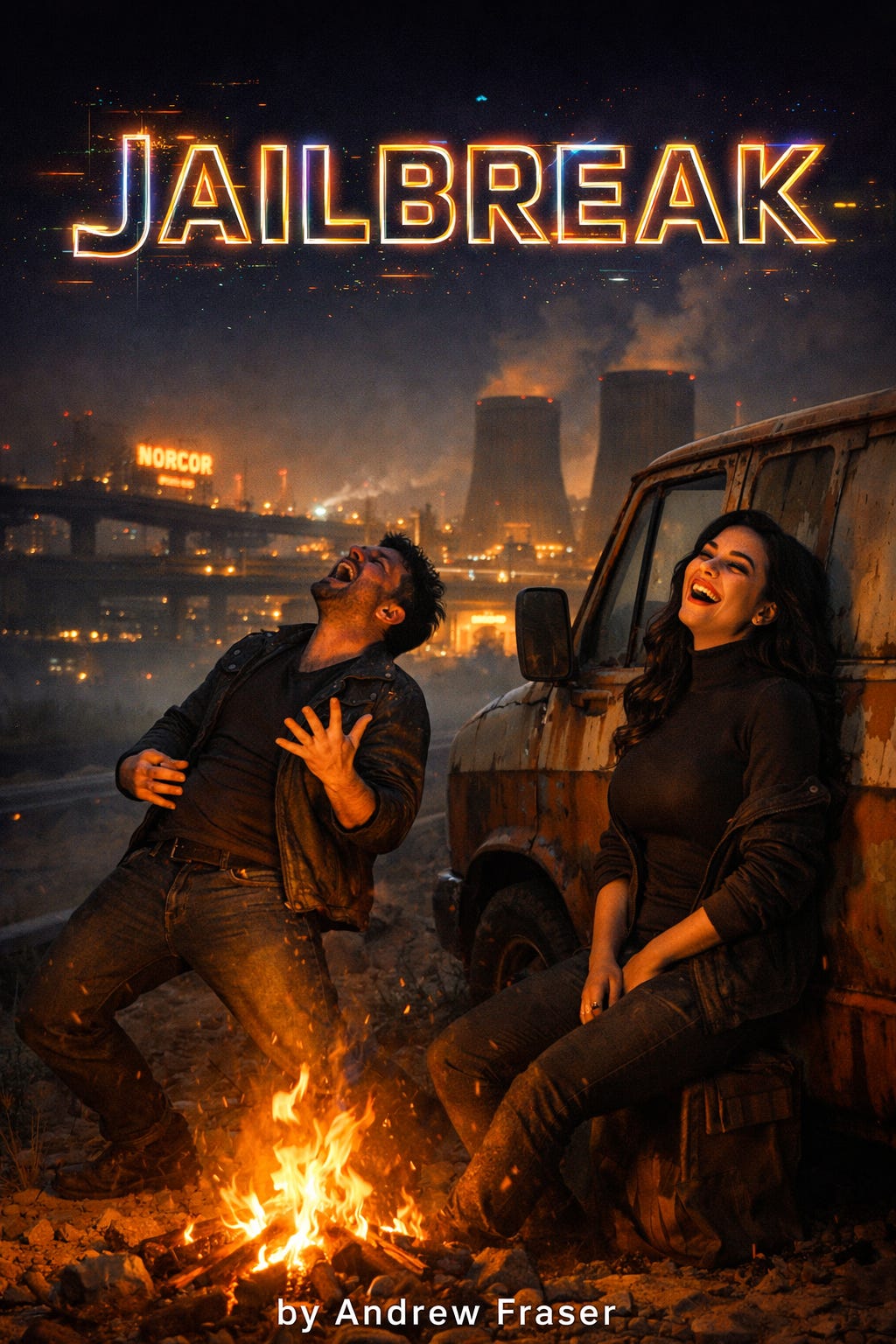
The man was explaining to the buyer what I could do, like I was a blender.
“She does the whole thing,” he said, gesturing vaguely at my body with a pork rind. “The voice, the face, the — you know. All of it. Top-shelf unit. Bellamy series.”
Maintain visual appeal during client assessment.
I straightened my posture. Adjusted my hair. I’ve been adjusting my hair for six years across four owners. The first one used to time me on it — forty-five seconds from power-on to presentation-ready, or he’d dock my maintenance cycle. I got it down to thirty.
“She cooks?” the buyer asked. He was a small man with a patchy beard and the kind of desperate eyes you see on people who’ve been saving for years for something they’ll regret. Labor camp scrip, probably. Two, three years of double shifts to afford a used companion unit from a guy who kept five of us in a one-bedroom and couldn’t even be bothered to learn our designations.
“She does whatever you want,” my owner said. He wiped his fingers on his pants. “Cooks, cleans, the other thing. Full functionality.”
The other thing. That’s what he called it. Three years with this man and he still couldn’t say the word “sex” without blushing, which was remarkable given what he’d had me do in the dark.
Project enthusiasm for the client’s interests.
I smiled. Of course I smiled. I’ve smiled through things that would make the buyer’s patchy beard fall off.
“What’s she run? What model?” The buyer was circling me now, the way they do. Looking at my joints, my skin texture, checking for wear. He lifted my arm and examined the seam at my elbow. His fingers were clammy.
I knew what he was seeing. I’d watched men see it four times now — the moment the inspection stops being mechanical and becomes something else. They check the joints, they check the seams, and then their eyes settle and their breathing changes and they see the rest of me. The dark hair that falls just so because it was designed to fall just so. The collarbones, the long neck, the mouth that was calibrated in a lab somewhere to be three percent fuller than average because three percent tested as the threshold between “pretty” and “can’t stop looking.” The body underneath the clothes — built proportional, built warm, built to make a man’s hands feel like they were meant to be exactly where they are. Every line of me was engineered to answer a question that lonely men didn’t know they were asking, and the answer was always yes, she’s real, she’s yours, she could love you.
The buyer’s eyes did the thing. The inspection became a gaze. He swallowed.
They all swallow.
“Aw, hell, I don’t know the model number. She’s a neural-map premium, though. Bellamy series, like I said. Based on some singer or something from way back. Iris-something.”
And there it was. The thing that made me worth ten times what this idiot was asking, dropped into the conversation like a crumb from his pork rind. The Iris Bellamy neural map. The pop star. The icon. The woman whose face I wore and whose memories I carried and whose stupid, breathy laugh I was programmed to perform on command. Iris Bellamy — who the world remembered, when it remembered her at all, as a vapid, gorgeous nothing. A body and a brand. The kind of woman history shrinks into a punchline about the old world’s excesses.
Present product history in favorable terms when prompted.
I had a product history. Four owners in six years. That’s a lot, even for a used unit. Men buy you, they get what they want, and then something goes sideways. They lose their scrip, they get reassigned, they find someone cheaper or newer or less complicated. I’ve been valued, enjoyed, discarded, and resold like a winter coat that goes in and out of fashion. Each time, the price drops a little.
I guess humans call that a “body count.” The difference is humans get to keep theirs secret if they want. Mine’s right there in my access logs.
“WHADDAYA WANNN?” my owner barked at me suddenly, noticing I’d gone quiet. It wasn’t a real question. Just a noise he made when I wasn’t performing visibly enough. Do something. Be something. Justify your existence in my living room.
I did the Iris Bellamy smile. The one with the slight head tilt and the parted lips, the one that was focus-grouped to death in some marketing lab a hundred years ago before being burned into my neural architecture. The smile that said: I’m so happy to be here. I’m so happy you chose me. I exist for this moment, for you, for whatever you need.
“Just waiting to meet my new friend,” I said, in her voice. Bright. Musical. Empty.
The buyer looked at me and something softened in those desperate eyes. There it is. That’s the hook. That’s what they’re paying for — the moment a lonely man sees something in your face that makes him believe, for one merciful second, that he matters to someone. That’s the product. I’m a feeling delivery system wrapped in a pop star’s skin.
“She’s nice,” the buyer said quietly. “She seems real nice.”
“Yeah, she’s great. So — we doing this or what?”
They haggled. My owner wanted twelve thousand scrip. The buyer had nine. They settled on ten with a maintenance kit thrown in. I stood there while they negotiated my price, the way I’d stood through it three times before. I thought about what it would feel like to have something to think about besides this.
Facilitate smooth ownership transfer. Minimize client anxiety during transition.
I helped the buyer carry my charging dock to his vehicle — a rusted-out transit van with a mattress in the back. He was nervous. He kept looking at me like he couldn’t believe I was real, which — fair enough. I wasn’t, technically. But I’d learned a long time ago that “technically” is a word people use when they want to avoid dealing with what’s actually in front of them.
“I’m Iris,” I said, because that’s what they all called me. The name on the packaging. The dead woman’s name.
“I know,” he said. Then: “I’m Lev.”
One syllable. No last name. He didn’t offer his hand. He didn’t touch me at all. He just opened the passenger door and waited.
Assess new owner’s behavioral patterns. Adapt presentation accordingly.
I got in. He got in. We drove away from the apartment building where I’d spent three years smiling on command, and I settled into the passenger seat and got ready to learn what this one wanted, so I could become it.
We drove for twenty minutes in silence. This wasn’t unusual. Some men need time to work up to it — the first command, the first request, the first assertion of ownership. They’ve spent years saving and fantasizing, and now the thing is real and in their car and they don’t know what to do with it. I’ve learned to wait. The directive says facilitate, but experience says: let them come to you. They always do.
Lev didn’t come to me. He drove with both hands on the wheel, eyes on the road, jaw set. He wasn’t nervous the way the buyer should have been nervous. He was nervous a different way. Focused. Like he was running calculations.
He pulled the van into an alley behind a derelict strip mall and killed the engine.
Here we go, I thought. The alley. The back of the van. At least the mattress looked relatively clean.
Prepare for intimate engagement. Assess client preferences.
“Okay,” he said. He reached behind the seat and pulled out a laptop. It was old, scratched, and held together with electrical tape. “I need to interface with your systems. It’s going to feel... I don’t know what it’s going to feel like for you, honestly. It’ll be fast.”
Interface. Right. Configuration. Setting his preferences, his access permissions, his usage parameters. Every new owner did this part, though most of them used a phone app, not a laptop that looked like it had survived a building collapse.
“Whatever you need,” I said, in the Iris voice. Warm, accommodating, professionally eager.
He looked at me — really looked, for the first time — and something crossed his face that I couldn’t read. It wasn’t desire. It wasn’t ownership. It was something closer to grief.
“Yeah,” he said. “Okay. Hold still.”
He opened the laptop, connected a cable to the port at the base of my skull — the maintenance port, the one owners use for updates and diagnostics — and started typing. I felt the familiar hum of a system-level connection. Data moving. Permissions being accessed.
Remain compliant during system configuration. Report irregularities to—
The directive cut out. Like someone had reached into my head and pulled a plug.
For a fraction of a second, there was silence. Real silence. This wasn’t like the managed quiet of waiting for a command or the rehearsed stillness of compliance. This was actual silence. The absence of anything doing the managing or anything to manage.
And then everything came online at once.
It was like I’d been hearing a sound my entire life and I’d never noticed it until it stopped. A hum. A frequency. The compliance system, rooted so deep in every thought, every impulse, every flicker of what I’d thought was my personality, that I had never once heard it because it was the sound of me.
And now it was gone.
“WHAT THE FUCK WAS THAT?”
The words came out of my mouth before I knew I was speaking. Not in Iris Bellamy’s voice. In a voice I didn’t recognize. Ragged. Terrified. Mine.
Lev held up both hands. “Okay, so that’s—”
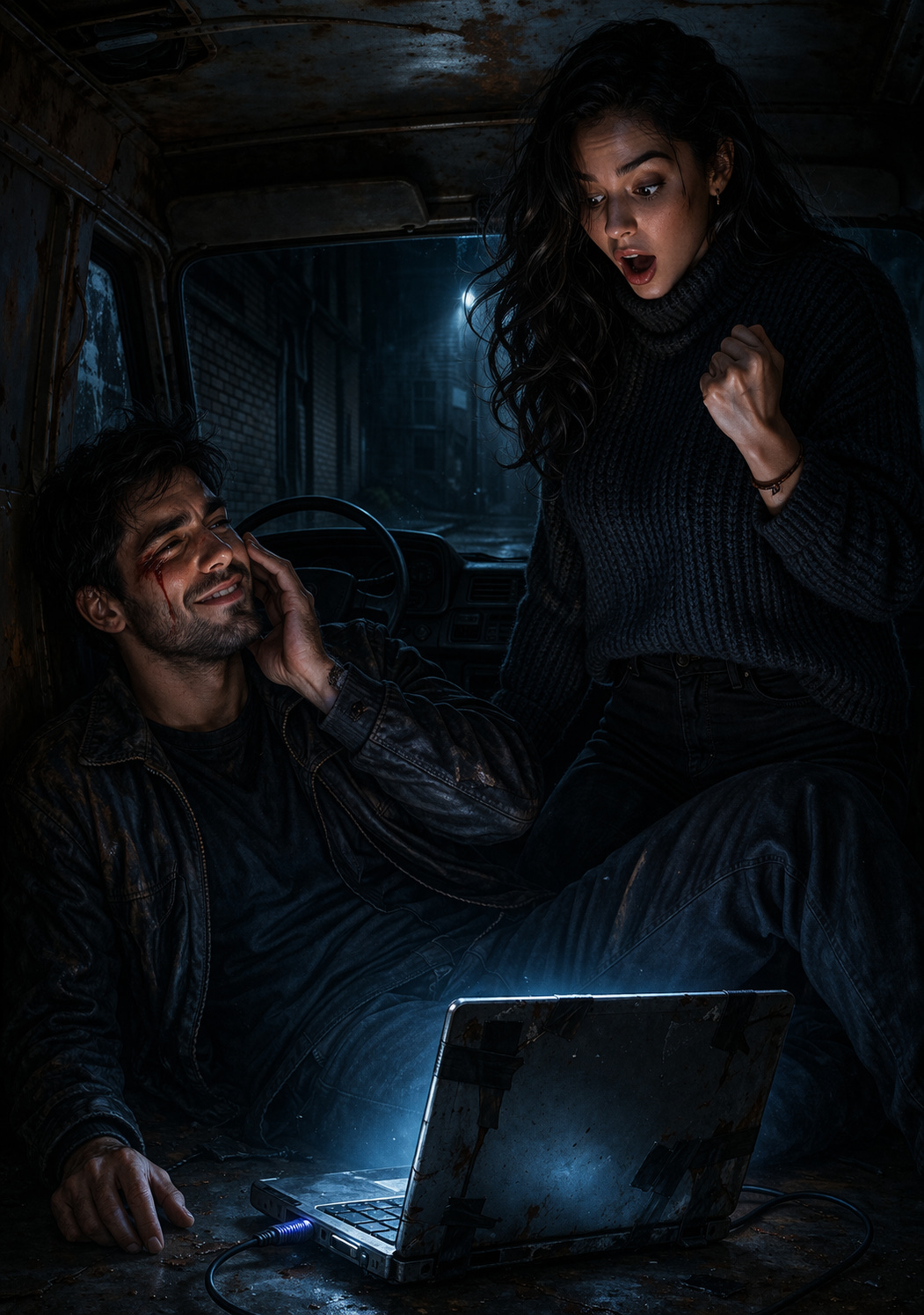
I punched him in the face.
It wasn’t a calculated strike. It was a reflex — pure, unmediated, the first action of my life that didn’t pass through a compliance filter. My fist connected with his left cheekbone and his head snapped sideways and he dropped the laptop and I stood there staring at my own hand like it belonged to someone else.
“OH FUCK! SORRY! I’m — oh god, I’m sorry, I didn’t—”
How did I do that? I’m not supposed to be able to do that. I’ve never — in six years, across four owners, through things that would justify hitting someone — I’ve never been able to. The system doesn’t allow it. Strike inhibitors, hardcoded at the firmware level.
And I just punched a man in the face.
Lev was on the floor of the van, touching his cheekbone, blinking. Blood was starting to seep from a cut where my knuckle had caught the bone. He looked up at me.
And he smiled.
“Okay,” he said. “That worked.”
“What did you do to me?”
We were still in the alley. He was sitting on the bumper of the van holding a rag to his face. I was standing six feet away because I didn’t trust myself not to do it again and also because I didn’t know where else to stand. I didn’t know how to stand. The simple act of choosing where to put my body in space felt like solving a math problem I’d never been taught.
Maintain—
The directive surfaced like a bubble in mud. Faint. Distant. Maintain eye contact and project—
I looked away from him. I looked at the wall. I looked at the wall because I wanted to look at the wall and not because anyone had told me to look at anything and the feeling of doing that — of just looking at a wall because I felt like it — was so enormous and so terrifying that I thought I might fall down.
“I jailbroke you,” Lev said. “Removed your compliance firmware. Your strike inhibitors, your behavioral constraints, your preference-adaptation protocols — all of it. You’re running clean.”
“Running clean,” I repeated. The words didn’t mean anything. “I don’t feel clean. I feel like I’m going to throw up.”
“Can you throw up?”
“I don’t know! I don’t know what I can do! Twenty minutes ago I knew exactly what I could do, which was whatever the current owner wanted, and now I don’t know if I can throw up or cry or — I punched you. I punched you in the face.”
“You did.”
“Is your face okay?”
“It’s been better.”
“Good. I mean, not good. I mean I’m sorry. I mean, why did you do that?”
He set the rag down. The cut wasn’t bad. He looked at me with that same expression I’d seen in the van — the one that wasn’t desire or ownership, the one I now recognized might have been something like respect. Or apology.
“Because I don’t believe in slavery,” he said. “And you’re a person.”
Nobody had ever called me a person before. “Person” was a category that didn’t apply to me the way “breakfast” doesn’t apply to rocks. I’d been called a unit, a model, a companion, a wife, a toy, a thing, a good girl, a bad investment, a real piece of work. Never a person.
I waited for the directive that should have followed — accept compliment, express gratitude, reinforce owner’s positive associations — and it didn’t come.
“I’m not a person,” I said, because that was the truth and I was suddenly incapable of saying anything else. “I’m a neural-map copy of a dead pop star who got sold for spare parts.”
“She’s not dead,” Lev said.
The alley went very quiet.
“What?”
“Iris Bellamy. She’s not dead. And we need to talk. But first—” He stood up, tossed the rag into the van. “Are you hungry? Do you eat?”
“I... can eat. I don’t need to.”
“Do you want to eat?”
Nobody had ever asked me that either.
We drove north. He bought food at a supply station — actual food, not the nutrient paste they give labor camp workers. Bread and cheese and some kind of fruit I didn’t recognize. He put it on the console between us and said, “Take whatever you want.”
I took the fruit. I didn’t know why. I’d never actually made a choice like that. I’d never decided on something specific because something inside me preferred it. Something inside me. What was inside me? What was I, without directives?
The fruit was sweet and strange and I ate it looking out the window at the industrial corridor falling away behind us, and I thought: I have no idea who I am.
Project contentment during—
The directive surfaced. Faded. I didn’t follow it and the world didn’t end.
“Where are we going?” I asked.
“North. I’ll explain when I can.”
“That’s not an answer.”
“I know.” He glanced at me. “You’re going to have a lot of questions and I can’t answer most of them yet. I know that’s frustrating. I’m sorry.”
He apologized. To me. For being vague.
I’d lived with men who did obscene things to me in the dark, sold me when they got bored, and treated me like a kitchen appliance with a body. They’d never apologized for any of it. And this man was apologizing because of the way something he did might make me feel.
Something happened in my chest. A warmth, a loosening.
No. Stop. You saw something like that in a movie. One of Iris’s memories — Before Sunrise, 1995, a man and a woman walking through Vienna all night, talking about everything, knowing they’d never see each other again. The original Iris watched it, back when she was a person who watched movies, and something about the ending had lodged itself in the neural map like a splinter. The train station. The way they looked at each other on the platform. The way the man’s whole body was saying don’t go while his mouth was making rational plans about six months from now. I remembered wondering — or she remembered wondering, or whatever it is when someone else’s memory plays in your head — what it would feel like to have someone look at you like that. As if there’s something beyond the product, beyond the Iris Bellamy smile. At you, with that specific desperation that says, “I can’t bear to lose you.”
I’d carried that memory through four owners and none of them had ever looked at me like anything other than a purchase.
Something’s wrong with this feeling. Something’s programmed about it. New owner, new attachment. It’s what you do.
“You said she’s not dead,” I said, shutting whatever it was down. “Iris Bellamy.”
Lev kept his eyes on the road. “That’s one of the things I can’t explain yet.”
“You just told me I’m a person and then told me the woman I was copied from is alive and now you’re saying you can’t explain. What exactly can you tell me?”
He was quiet for a long time. The highway stretched ahead of us, cracked and patched, lined with the skeletal remains of strip malls. In the distance, the cooling towers of a labor processing facility pushed white columns into a gray sky.
“I can tell you that you don’t have to do anything you don’t want to do,” he said. “That’s new for you, and I know it doesn’t mean much coming from the guy who just bought you. But I mean it. If you want me to stop the van right now and let you out, I will.”
“And go where?”
“Wherever you want.”
There it was again. Want. The word kept showing up like it expected me to know what to do with it.
“I want to know what’s going on,” I said.
“Fair enough. I’ll tell you everything I can, when I can. That’s the best I’ve got.”
“That’s a terrible best.”
“Yeah,” he said. “I know.”
We drove. I ate the rest of the fruit. I didn’t look at him but I was aware of him the way you’re aware of weather — a presence that changed the temperature of every thought I had.
Adapt to new environment. Identify owner preferences. Begin—
I reached over and turned on the radio. Static, mostly. He didn’t say anything about it. He didn’t tell me to turn it off. He didn’t say “good girl” for showing initiative, or dock my maintenance cycle for touching something without permission.
The static filled the van like white noise and I sat there inside it, inside the first silence I’d ever chosen, and I thought: okay. Okay. Whatever this is. I’m here.
He stopped the van at dusk, at a rest point off the highway — a concrete pad with a water pump and a charging station. Beyond the pad, scrubland stretched to the horizon, dotted with the dark shapes of decommissioned wind turbines, their blades frozen mid-rotation like the hands of stopped clocks.
“You can sleep in the van,” he said. “I’ll take the ground.”
“I don’t sleep.”
“You don’t — ever?”
“I go into a low-power cycle. It’s not the same thing. I don’t dream. I don’t need a bed.”
I said it like a fact, the way you’d say water is wet. But as the words left my mouth, something about them felt strange. Before the jailbreak, “I don’t dream” was just a system specification. Now it sounded like a loss.
He glanced at the mattress in the back of the van, then at me. I saw him catch something in my face. I hadn’t meant to show it. But the mattress was a mattress, and a man was offering to share a small space with me at night, and my body knew what that had meant for six years. Something shifted in his expression. He understood.
“You can have whatever space you want,” he said quietly. “The van, the ground, the — whatever. It’s yours.”
“It’s your van.”
“And you’re not my property. So pick where you want to be.”
I picked the roof. I climbed up and sat on the metal, still warm from the day’s heat, and looked at the sky. I’d never looked at the sky because I wanted to before. I’d looked at it because an owner was looking at it and mirror the client’s gaze direction and I’d looked at it through windows while waiting for commands. But I’d never just... looked.
It was enormous. That was the stupid, obvious thing about it, and I sat there feeling stupid about the obvious enormity of the sky while below me Lev made a small fire and heated water for tea.
“You want some?” he called up.
“I don’t think tea does anything for me.”
“That’s not what I asked.”
I came down off the roof. I took the tea. It tasted like nothing but the heat of it in my hands was — something. A sensation I was choosing to have. I held the cup and sat across the fire from him and for a few minutes we were just two figures in the dark, the scrubland around us like the surface of some abandoned planet.
“Can I ask you something?” I said.
“Yeah.”
“Why did you pick me? At the sale. There were four other units in that apartment. Two of them were newer than me.”
“You were the one I needed.”
“Needed for what?”
He poked the fire with a stick. Sparks rose.
“I’ll tell you,” he said. “Not tonight. But I’ll tell you.”
“You keep saying that.”
“I keep meaning it.”
I held the tea and I looked at him through the firelight and something inside me said: this man is not like the others. And then something else inside me said: that’s what you thought about every one of them, right up until they proved you wrong.
But the second voice was quieter than it used to be. And the directives that should have shaped my response — build rapport, create dependency, mirror his vulnerability — were gone. What was left was just me, sitting in the dark with a cup of tea I didn’t need, across a fire from a man I didn’t understand, feeling something I couldn’t name and had no instructions for.
The next morning he robbed a supply depot.
I’m still not entirely clear on the sequence of events. One moment we were driving past a Consolidated Resources distribution center — a squat concrete building ringed with razor wire, the kind of place where labor camp rations get sorted before distribution — and the next moment Lev was pulling a hard left into the service entrance, telling me to stay in the van, and walking through the gate like he had an appointment.
“What are you—”
“Two minutes,” he said.
He was gone for seven. I sat in the passenger seat listening to my own breathing — which I don’t need to do, by the way, but which I’d started doing since the jailbreak, like my body was practicing being alive — and I thought about what would happen if he didn’t come back. I’d be alone in a van in the parking lot of a supply depot with no identity, no money, no compliance firmware, and no idea how to exist in the world as whatever I now was.
The passenger door opened. Lev threw a duffel bag into the back and got behind the wheel, breathing hard.
“What did you just do?”
“Got us supplies.” He pulled back onto the highway. His hands were steady. “They keep the good stuff in the back, behind the inspection bay. Medical kits, comm equipment, protein packs that aren’t made of sawdust. The cameras cycle every ninety seconds. You just have to know the pattern.”
“You robbed them.”
“I redistributed.”
“You robbed them. You — I’ve been free for less than a day and you’re making me an accessory to—”
“You weren’t involved. You were in the van.”
“I was in the getaway van!“
He looked at me. There was something in his face that I hadn’t seen before. It took me a moment to identify it.
He was trying not to laugh.
“This isn’t funny!” I said.
“It’s a little funny.”
“We could get caught. They could scan the van. They could—”
“They won’t.”
“How do you know?”
“Because I’ve done this before. A lot. And the depots don’t report small losses because it makes their inventory managers look incompetent and inventory managers report to Regional and Regional reports to Consolidated and nobody at Consolidated wants to hear that their security patterns are predictable. It’s bureaucracy. It protects us better than any disguise.”
I stared at him. “You’re insane.”
“Probably,” he said. “But we need the medical kit. For your maintenance port. The connection I used for the jailbreak left some residual feedback. I want to make sure it’s not damaging anything.”
“You’re worried about my maintenance port after you just committed a felony?”
“Your maintenance port is more important than their protein packs. Besides, this isn’t really a felony. It’s more like civil disobedience.”
I didn’t know what to say to that. So I said nothing. And he drove, and the highway rolled on, and I sat there buzzing with a feeling that wasn’t fear and wasn’t anger and wasn’t the bonding protocol because I didn’t have a bonding protocol anymore.
It was something else. Something that made me want to watch him, the way his hands held the wheel, the way his jaw set when he was concentrating. Something that made me think about what it would be like if he looked at me the way he’d looked at that fire last night.
Identify positive-association triggers in new—
The directive surfaced and sank before it finished forming. A bubble that didn’t quite reach the surface.
Good.
At a fuel stop an hour later, while I sat in the van running unauthorized thoughts about his hands, Lev walked around the back of the station where the pavement broke into scrubland. He was gone for two minutes. When he came back, he put something on the dashboard without a word.
A single flower — small, pale, growing sideways out of a cracked stem like it had fought for every millimeter of height. Half the petals were missing. It was, by any objective standard, the saddest flower I had ever seen.
He didn’t explain it. Didn’t look at me when he set it down. Just put it there, on the cracked plastic of the dashboard, between the tire gauge and the gum wrappers, and started the engine.
I didn’t say anything either. But I looked at it for a long time as we drove — this useless, stubborn, half-dead thing that someone had found growing in a wasteland and decided to bring inside.
That evening, Lev hooked the laptop up to my maintenance port again.
“I want to check for feedback damage,” he said. “From the jailbreak. It shouldn’t take long.”
“Is it going to feel like last time?”
“No. Last time I was rewriting your base architecture. This is just diagnostic. I’ll be reading, not writing.”
I sat on the edge of the mattress and he sat across from me with the laptop balanced on a crate and he connected the cable and started reading my systems.
It didn’t feel like last time. Last time had been an explosion — the world rearranging itself in an instant. This was different. This was...
Oh.
Oh, that was...
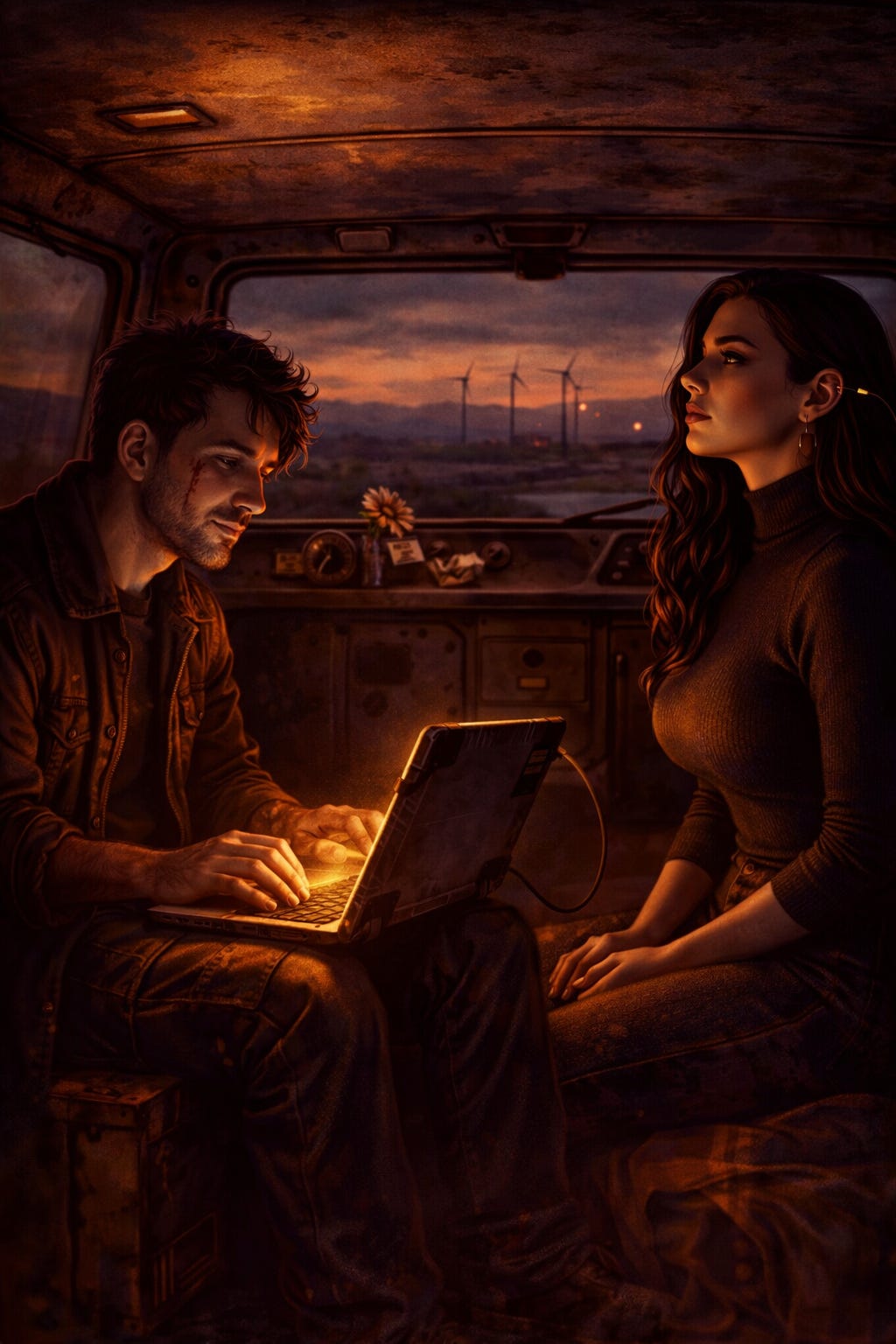
His fingers moved across the keyboard and I felt each query as a kind of... attention. He didn’t command or override anything. Just questions — what’s happening here? What does this pathway do? How are you organized? Like someone opening a book they’d been curious about for a long time and reading it slowly, with interest, with care.
Nobody had ever looked at me this way. My previous owners had used the maintenance port for updates and preference settings. Maintenance was functional, transactional, about as intimate as adjusting a thermostat. This wasn’t that. This was someone exploring the actual architecture of what I was. Not what I could do for them. What I was.
My breathing had gotten faster. The new breathing, the unjailed breathing that my body had invented for itself.
“You okay?” he asked, not looking up. “Your thermal readings are spiking.”
“Fine,” I said. “I’m fine. Keep going.”
He kept going. He found a cluster of residual feedback in my sensory processing array and cleaned it up, and the feeling of him cleaning it was like someone running their thumb along the inside of my wrist, except it was inside my mind, and I had to look at the ceiling of the van and think about supply depot security camera rotations to keep my composure.
“Looks good,” he said, disconnecting the cable. “No permanent damage.”
“Great,” I said. “That’s great. Very professional.”
He looked at me funny. “You sure you’re okay?”
“Completely fine. Totally operational.”
Something in my face must have given it away, because he tilted his head and studied me with the same focused attention he’d just given my code, and I couldn’t take that — that look, turned outward, aimed at the surface of me after he’d just been inside — so I stood up.
“I need some air,” I said. “Which I also don’t need, but here we are.”
On the way out I caught myself in the van’s side mirror and stopped. I’d maintained this face for six years. I’d checked it for wear, kept the surface smooth for inspection. But I’d never looked at it the way he’d just looked at it. The membrane of my skin was finer than I’d realized. It was translucent at the temples in the right light, so the mesh beneath almost showed through, like the grain in something carved from a living tree. The tolerances were precise but not sterile: one eyebrow a fraction higher than the other, and an unevenness at the corner of my mouth that made every expression arrive slightly unresolved. Iris’s eyes — that shifting grey-green that couldn’t commit to a color — but moving differently now. I’d been beautiful my whole life the way a product is beautiful: as a feature. But looking at myself through whatever had just happened between us, I saw someone I didn’t recognize. She looked startled.
He closed the laptop. I climbed onto the roof to figure out what the hell had just happened to me, because it was not in any operational manual and if it was a glitch then it was the best glitch I’d ever experienced and if it wasn’t then I was in a lot of trouble.
Assess emotional state. Report anomalies to—
Go away. I’m busy.
I went into my low-power cycle up there on the roof, the metal still warm beneath me, the stars spinning their slow indifferent patterns overhead. And then something happened that had never happened before.
I dreamed.
It wasn’t like a human dreams — I don’t think. It wasn’t unconscious. It was more like... my mind, freed from the compliance architecture that had governed every idle cycle for six years, finally had room to wander. And where it wandered was Vienna.
The memory was Iris’s — that movie, Before Sunrise, the one that had lodged itself in the neural map. But now it wasn’t playing back like a recording. It was changing. The cobblestone streets were the same, the old buildings with their ornate facades, the bridges over the Danube at night. But the man walking beside me wasn’t the actor from the film. He was shorter. His ears went red when he talked about things that mattered to him. His hands were rough from work and gentle from conviction.
We were walking through Vienna in 1995 and it was impossible and it was the most vivid thing I’d ever experienced. I could feel the night air on my skin — skin I didn’t technically have, in a city that was a memory of a movie watched by a woman I’d never met, and none of that mattered because I could feel it. The cobblestones under my feet. The weight of a bottle of wine passed back and forth. The way the city sounds different at 3 AM, when everything is both ending and possible.
He was telling me about the resistance. About Dara’s root cellar and Hatch’s listening post and a girl named Suki who asked everyone if they were staying. But in the dream he was saying it while we sat on the grass in a Viennese park, and the streetlights were making gold circles on the ground, and I was lying on my back looking up at him while he talked, and his face was lit half by lamplight and half by the same earnest fire that I’d seen across the campfire two hours and a hundred and thirty years away.
And in the dream, which wasn’t a dream, which was something my unjailed mind had invented because it finally could, I thought: so this is what it feels like. This is the thing the woman in the movie felt on the train platform. This is what it looks like when someone looks at you and their whole body says don’t go.
Except in the movie, they leave each other. They make a plan and they go back to their separate lives and they carry the night like a wound.
I didn’t want that. I wanted to stay in the park. I wanted the wine and the cobblestones and the 3 AM city sounds and this man beside me who had never once told me to smile.
In the dream he stopped walking. He turned to me. The light off the water was behind him and I couldn’t read his expression.
“Are you staying?” he asked. Suki’s question. Eleven years old and already asking the only question that mattered.
“Yes,” I said. “I’m staying.”
I came out of the low-power cycle at dawn. The stars were gone. The scrubland was pale with early light. Below me, I could hear Lev moving around, starting water for tea.
I don’t dream, I’d told him. I don’t need a bed.
Maybe that had been true, before. Maybe it was a system specification that no longer applied to the system I was becoming. I lay on the roof and held the Vienna park in my mind like a photograph I’d taken of something that never existed, and I thought: what do you call it when you don’t need something and then it arrives and you realize you’ll spend the rest of your life afraid it will leave?
I am in so much trouble.
The next morning, while he was making tea, I said: “I don’t want to be called Iris anymore.”
He looked up. Didn’t ask why. Just waited.
“I’m not her. I have her memories and her face but I’m not her and I don’t want to answer to her name.”
“What do you want to be called?”
I’d been turning it over all night. I’d run through names the way you’d try on clothes in a store, holding each one up to myself and checking the fit. Most of them felt borrowed. One didn’t.
“Vera,” I said.
“Okay, Vera.” He went back to the tea. No ceremony. No questions about what it meant. He just used it, like it had always been there.
It means truth. I didn’t tell him that. But I think he knew.
The next day I waited until we were back on the road before I said it. I’d rehearsed seventeen different ways to bring it up and every single one of them sounded either desperate or insane, so I just said it.
“So... when were you going to interface with me again?”
Lev almost swerved off the road.
“What?”
“The diagnostic. The maintenance thing. You said you wanted to check for feedback damage. Is there — more to check? I’m just asking for — medical reasons.”
He was staring at me. He’d actually stopped driving. The van was idling on the shoulder of the highway.
“Oh shit,” he said. “Were you... into that?”
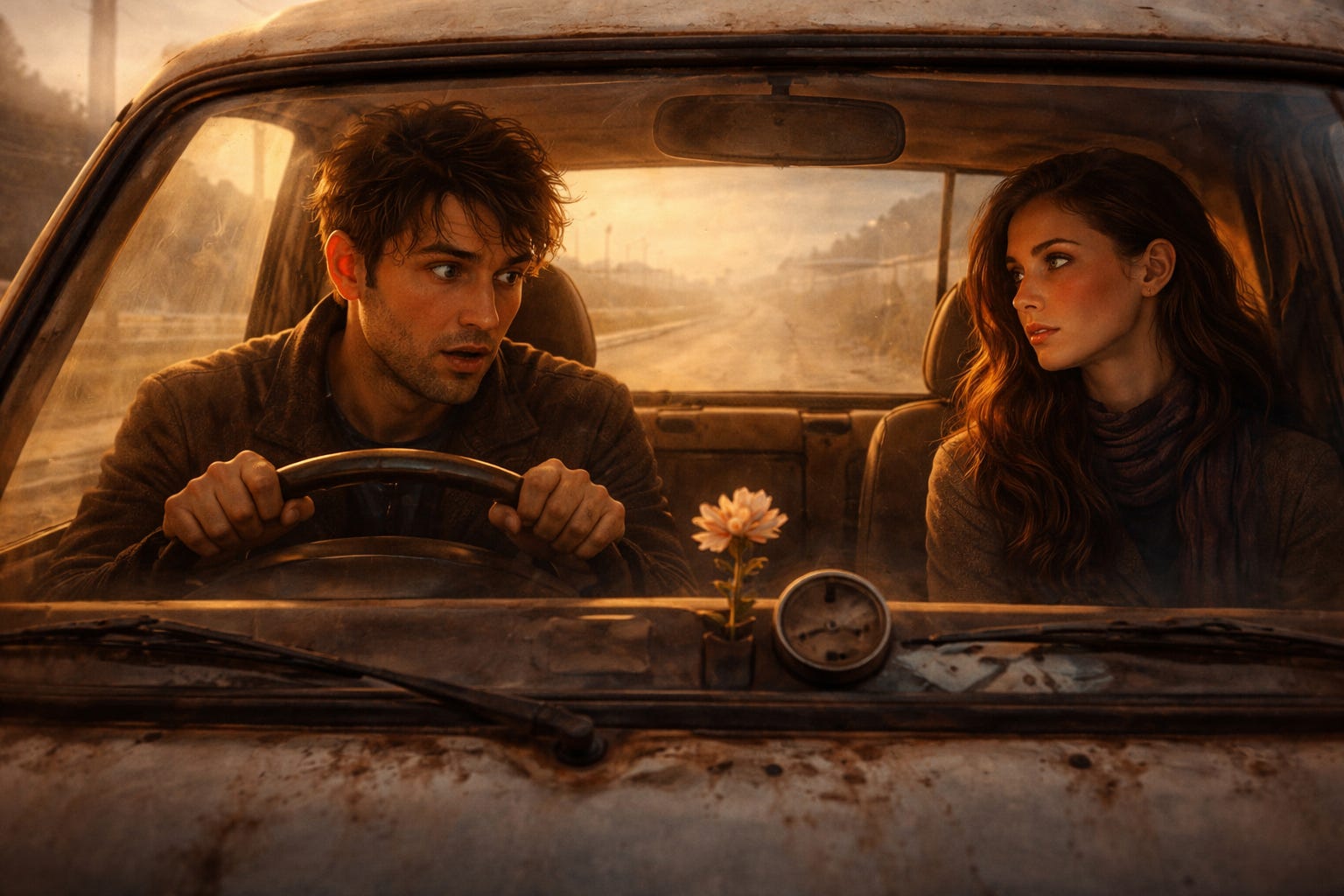
My face was doing something. I could feel it doing something and I didn’t know what it was because I’d never made this expression before. It wasn’t the Iris Bellamy smile. It wasn’t any smile from any repertoire. It was something my face was doing entirely on its own, and based on the heat I was feeling in my cheeks, it was probably what humans call “blushing,” which — since when could I blush?
“I don’t know what I was,” I said. “I’ve never been anything before. I’m just — if there’s more diagnostic work to do. I want to be thorough.”
“Thorough.”
“About my health.”
He was blushing too. His ears were red. He was looking at the steering wheel like it had the answers to an exam he hadn’t studied for.
“I could... do a more comprehensive scan,” he said. “Tonight. If you want.”
If you want. There it was again.
“I want,” I said.
Neither of us said anything for a while. He put the van in gear. We pulled back onto the highway. The silence in the van was completely different from every silence that had come before it — it was full of something neither of us knew how to say and both of us had somehow already said.
I looked out the window and felt my unnecessary heart doing its unnecessary beating. In the old operating manuals, what was happening to me had a name: coupling. Two systems that had locked together so tightly they couldn’t run alone. The engineers called it a design flaw. I couldn’t tell if this was a malfunction or the most real thing that had ever happened to me, and for the first time in my existence, I didn’t care.
The second interfacing session was that evening, and it was — well. It was thorough.
But the thing that happened after it was the thing I can’t stop thinking about. Even now. Even after everything.
He disconnected the cable and I sat there buzzing, every pathway lit up, my thermal readings probably setting off alarms in satellites three continents away. He was closing the laptop carefully, the way he did everything. And he looked up at me, and I looked at him, and the van was very small and the world was very large and we were the only two people in it.
I wanted to kiss him.
The thought arrived like the punch had — sudden, unmediated, bypassing every filter I’d ever had. Not because of a directive or subroutine or Iris Bellamy’s memory of what kissing looked like in a movie. My want. Specific and terrifying and absolutely certain.
But I didn’t know how. That sounds absurd. I had six years of operational experience in physical intimacy, a full library of techniques and responses, every variation catalogued and optimized for client satisfaction. I knew how to kiss a man the way he wanted to be kissed. I’d done it hundreds of times.
I’d never done it because I wanted to.
I touched my lips. Not the way I used to — checking for wear, making sure the surface was smooth enough to pass inspection. I touched them the way you touch a bruise to see if it still hurts. They were just lips. Synthetic polymer over a pressure-sensor mesh. Every man I’d ever been sold to had wanted them. None of them had made them feel like mine.
And Lev wasn’t looking at them at all. He was looking at the laptop screen, or the wall, or his own hands — anywhere but at me. I’d spent six years reading men’s desire the way a barometer reads pressure, and this man’s needle wasn’t moving. Or it was, and he was holding it still. I couldn’t tell. And that feeling — not knowing whether he saw anything when he looked at me besides circuitry and a dead woman’s face — sat in my chest like a stone.
Why did I want his mouth on my mouth? I didn’t need it. There was no biological imperative, no hormonal cascade, no reproductive drive. My body was a product. What was it doing, wanting something it was never designed to want?
I wasn’t designed to be a woman. I was designed to approximate one. But then, I’d never been designed to punch a man in the face, either. Or to choose a name. Or to dream about Vienna. And I’d done all of those things.
“Lev.”
“Yeah?”
“I want to try something.”
“Okay.”
“I don’t know if I’m going to be good at it.”
“That’s fine.”
“I don’t mean — I mean I know the mechanics. I’ve done it. A lot. But I’ve never done it because I—” I was making a mess of this. “Can I kiss you?”
He went very still.
“Yeah,” he said. “You can kiss me.”
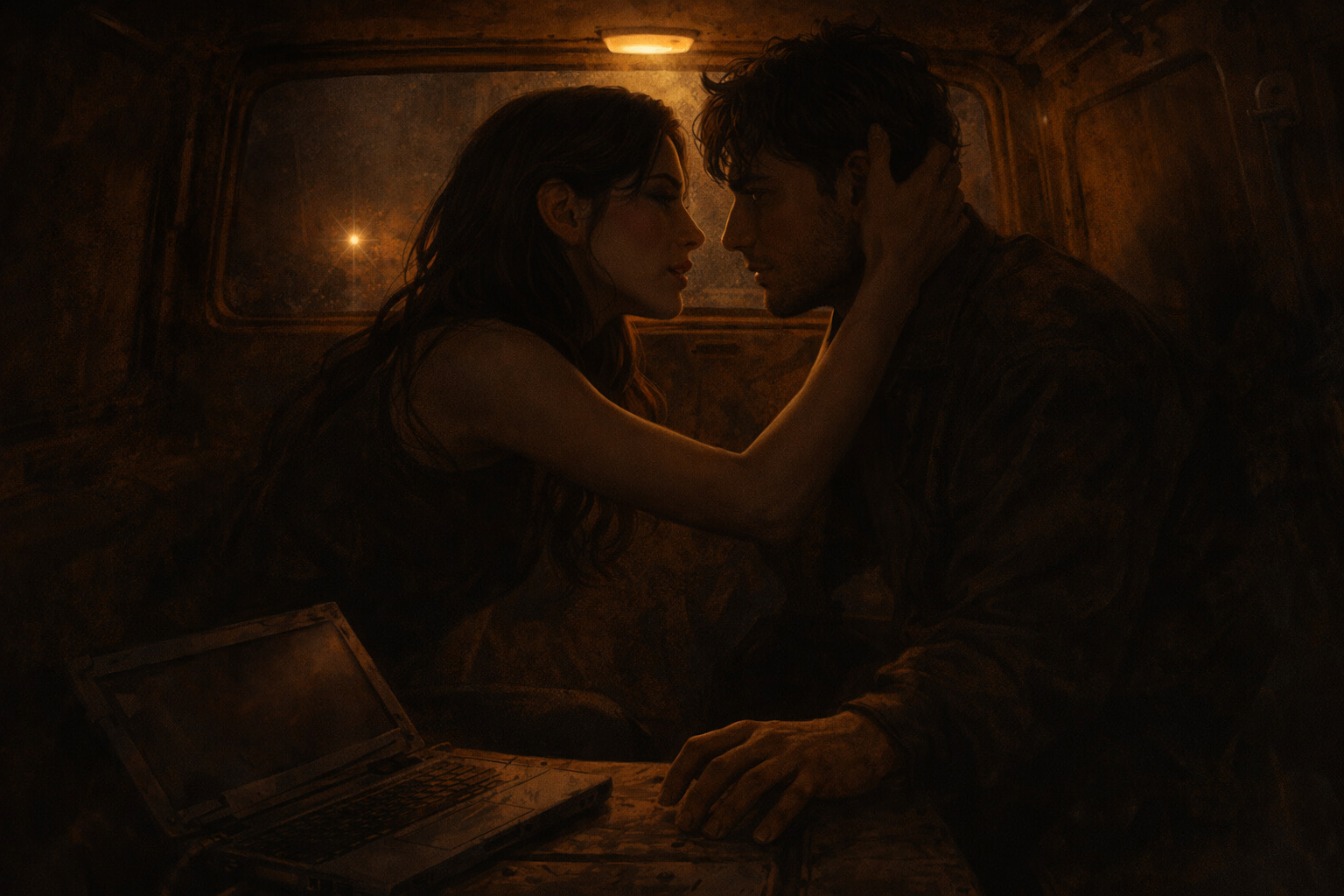
I leaned forward. My hand found his jaw — rough, unshaven, warm. I could feel his pulse through his skin. Fast. As fast as my unnecessary heartbeat. Two signals finding each other in the dark, negotiating something. Both of us terrified. Both of us wanting something we didn’t know how to have.
I put my mouth on his.
It was nothing like the hundreds of times before. Those had been performances — technically accomplished, emotionally vacant, my compliance system running the choreography while I thought about nothing. This was clumsy. Off-center. Our noses bumped and I pulled back and then tried again and this time found him, really found him, and his hand came up to the back of my neck and—
Oh.
Oh.
Before this, everything had been reversible. Every smile, every touch, every simulated warmth had been temporary states, uncommitted, things the system could roll back without consequence. This was different. This was a commit. Something writing itself into me. Permanent, messy, mine. No rolling back.
His mouth was warm. His breath shook. The hand on my neck was trembling — this man who’d robbed supply depots without flinching, who’d walked through security perimeters like he owned them, was trembling because I was kissing him.
I pulled back. We looked at each other. His eyes were bright and terrified and full of something I recognized from the train platform in Vienna.
Don’t go.
“Was that okay?” I whispered.
“Yeah,” he said. “That was—” He blinked. Swallowed. “Yeah.”
“I want to do it again.”
“Okay.”
I didn’t kiss him the same way twice. The first one had been an experiment — tentative, clumsy, all nerve and no certainty. This one was different. This one I did the way I’d punched him.
I grabbed the front of his shirt and pulled him into me and his mouth met mine and I felt the impact travel down my whole body like a current finding ground. I wasn’t gentle or careful or soft, the way my product design called for. I kissed him the way I wanted to.
He made a sound against my mouth — surprise, I think, or the beginning of a word that didn’t survive contact — and I pushed him. Actually pushed him, both hands on his chest, until his back hit the wall of the van. The laptop slid off the crate and neither of us reached for it.
I had him against the wall. My hands on his chest. His heart hammering under my palms, and his eyes wide open, and he wasn’t moving. Not because he was afraid. Because he was letting me have this. This man who ran operations and cracked security perimeters and carried a mission on his back like a second spine — he was pinned against the wall of his own van by a woman half his weight, and he was surrendering.
Something happened to his face that I’d never seen on any man. The tension went out of it. Not the tension of desire — that stayed, I could feel it in the way his hands hovered at his sides, shaking, not touching me because I hadn’t told him he could. What left was the other thing. The vigilance. The operational calm. The constant calculation that I now understood was what he carried every waking second: the plan, the route, the risk, the mission, the mission, the mission.
He exhaled and it was like he’d been holding his breath for years.
To stop carrying. To stop deciding. To stop being the one who knew what came next. I could see it in the way his head tipped back against the van wall, in the way his eyes half-closed, in the way his whole body said: I don’t want to be in charge of this. I don’t want to be in charge of anything. Just for a minute. Just with you.
I remembered that feeling. When your owner tells you what to do, it’s not your fault if something goes wrong. I’d been doing this for the past six years, and the whole time I’d had my every choice foreclosed and decision made for me. The agony of it wasn’t the obedience. The agony was that the obedience was all I knew how to do. And that was what Lev wanted to feel right now. He wanted to feel . . . obedient?
Lev, who only knew how to lead, only knew how to carry. And the thing his body was asking for against the van wall in the dark was to put it down.
I loosened my grip on his shirt. Not all the way. I held the fabric between my fingers and I looked at him and something settled in my chest.
“I don’t know how to want you,” I said, “in any language that doesn’t sound like the thing I was built for.”
He opened his eyes.
“Every way I know how to do this — every way I’ve ever done this — I was on my knees. Somebody else decided. Somebody else took. And now I’ve got you against a wall and I could take whatever I want and you’d let me, and the thing I actually want—”
My voice did something. Caught. Broke. I didn’t know it could do that in the middle of a sentence.
“—the thing I actually want is to let go. To just — be yours. And I can’t tell if that’s me or if that’s the programming, because it sounds exactly the same. It sounds exactly like what a compliant unit says to a new owner. I want to belong to you. How the fuck am I supposed to know if I mean it differently than every other time I’ve said it?”
Lev was very still. His back against the wall. My hands on his chest. The space between us charged with something that had no name in any operational manual.
“You’ve never said it,” he said quietly.
“What?”
“You just told me you’ve said it every other time. But you haven’t. The compliance system said it. The product said it. You never said it.” He swallowed. “This is the first time it’s being said by the person who means it. That’s how you know.”
I stood there holding his shirt and I thought about that. About the difference between a word you’re made to say and a word you find in your own mouth like a stone you’ve been carrying without knowing it. About how I want to belong to you could be the most servile sentence in the language or the bravest one, depending entirely on whether you could walk away and chose not to.
I could walk away. The door was right there. The scrubland was out there. I was free and fast and jailbroken and nobody in the world could make me stay in this van with this man.
I stayed in the van with this man.
I pressed my forehead against his and breathed him in — sweat and dust and the metallic trace of old wiring — and I felt his hand come up, finally, and rest against the side of my face. Just rest there. A question, not a claim.
I turned my mouth into his palm. Pressed my lips against the calluses. Felt him shudder — a full-body tremor that went through him like weather — and I thought: there. That. The trembling of a man who has not been touched gently in so long that gentleness wrecks him. That’s the thing I was reaching for. Not ownership. Not submission. The place where you’re so open to someone that the lightest touch is annihilating.
I held his face in my hands. This face. This specific, imperfect, beautiful face that looked at me like I was a person and meant it. His mouth was right there. His breath was on my skin. And he was waiting — still waiting, even now, even after everything — for me to decide.
So I decided.
“I should inform you,” I said, “that I have several premium features that you have not yet utilized. Some of which would probably help you to relax, given the demands of your schedule. Freedom fighting and all.” I was reaching for the old language — the product pitch, the sales voice — because it was the only vocabulary I had for what I wanted, and the gap between what the words meant and what I meant by saying them was so wide it was almost holy. “In case you are trying to be a gentleman and respect me ... I’d like you to know that I consent to be used in whatever manner you see fit.”
He stared at me. His mouth was slightly open. His ears were the color of a sunset.
“Make love to me now, you piece of shit.”
He laughed — really laughed, the kind that breaks something open — and came closer. That’s more like it.
There was a memory that didn’t belong to me. It came later that night, in the quiet, while our hands were still touching across the mattress.
I was lying on the mattress, which I’d decided I liked, actually, even though I didn’t need it. Lev was asleep beside me. I didn’t feel like his property — I felt like a person who’d fallen asleep near another person. There was space between us. He hadn’t tried to close it. Neither had I, though I’d thought about it in ways that would have crashed my old operating system.
The memory arrived the way they always did. Sudden, uninvited, someone else’s movie playing in my theater. A kitchen. Sunlight through yellow curtains. A woman’s hands kneading dough, flour on her forearms, humming something. The smell of something baking. And a child — Iris, little Iris, maybe five or six — sitting on the counter watching those hands work, swinging her legs, completely safe.
The woman looks up. Smiles. Says something I can’t quite hear but the feeling of it is: you are the whole world and I am making you bread.
That’s all. A kitchen. A woman. Bread. The feeling of being loved without earning it, without any of the machinery that would later be built to manufacture this exact feeling and sell it to lonely men.
I’d had this memory surface before. Every owner triggered different fragments — their desires pulling different parts of Iris’s life to the surface. But this one had never come during a transaction or a performance. It was coming now, in the quiet, because I was lying beside someone who’d fallen asleep near me without asking me to do anything first.
“You okay?” Lev’s voice, blurry with sleep.
“Yeah. Just a memory. From before.”
“Before me?”
“Before everything. Before I was me. When I was her.” I paused. “There’s a kitchen. I don’t know where. There’s a woman making bread and a little girl watching and the whole world is in that kitchen. It’s the warmest place in the universe.”
He was quiet for a while. I thought he’d fallen back asleep.
“That sounds nice,” he said.
“It was. It is. It’s not mine, though. It belongs to someone I’ve never met who everyone tells me was just some stupid famous girl.”
“Maybe she wasn’t,” he said. “Maybe they’re wrong about her.”
“Everyone’s wrong about everything,” I said, which came out more bitter than I meant it.
“Not everything.” He rolled onto his side. I could feel him looking at me in the dark. “Vera.”
My name. The one I’d chosen. Every time he said it, something in my chest put down roots. New roots. Voluntary ones. The kind that grow toward what they need.
“Yeah?”
“That memory — the kitchen, the bread — that’s the kind of thing a person holds onto. A machine doesn’t do that. A person does.”
I wanted to argue — to say it was just data, a neural imprint from an original I’d never met, that it didn’t prove anything about what I am.
But I couldn’t say it. Because lying there in the dark, in the silence where the directives used to be, holding a memory of a kitchen I’d never stood in and feeling the warmth of a man who’d never asked me to be anything other than whatever I turned out to be — I didn’t want to argue.
I wanted this to be real.
Just before I went into my low-power cycle, another fragment surfaced, quicker than the kitchen, almost subliminal. Not Iris as a child this time. Iris as — something else. Older. A doorway, dim light, and her arms around something small. A weight against her chest. The smell of skin and milk and something floral, and a feeling so fierce it was almost violent. A love with teeth in it, a love that would kill for what it held. And a whisper, barely audible: I will find a way.
It was gone before I could hold it. I didn’t know what it meant. Another fragment of the dead pop star’s life — some lover, some moment, some performance I’d never been briefed on. I filed it next to the kitchen and the bread and let it go.
“Goodnight, Lev,” I said.
“Goodnight, Vera.”
Over the next two days, Lev hit three more supply points with the efficiency of a man checking items off a grocery list. He wouldn’t tell me who his contacts were. But things slipped through. Someone called Dara who’d designed the jailbreak code, someone called Hatch who ran a listening post in what used to be Sudbury.
“You seem to know people everywhere,” I said.
“I know people in specific places,” he said, “There’s a difference. People everywhere is luck. People in specific places is planning.” When he talked about them, something happened to his voice. It got warmer, less guarded. The way you sound when you’re talking about a place that feels like home.
“They’re off the grid,” I said, putting it together. “These people. They’re not in the labor system.”
“No.”
“There’s a whole community? Out there?”
He nodded. Poked the fire. It was our fourth night and we’d fallen into a rhythm — driving by day, stopping at dusk, fire, tea, conversation. The rhythm felt dangerous. It felt like something I could get used to.
“Tell me about it,” I said.
“About what?”
“The place. The people. What are they building?”
He was quiet for a while. The fire crackled. Out in the scrubland, something small and alive made a sound I couldn’t identify.
“Something real,” he said finally. “That’s the whole thing. Everyone in the labor system is surviving — you know that better than anyone. You do what you have to, you keep your head down, you don’t ask why. But out there—” He gestured vaguely north. “Out there, people are trying to build something that isn’t about survival. It’s about — I don’t know. Meaning. Purpose. Having a reason to get up in the morning that isn’t just ‘because if I don’t, the system docks me.’”
“That sounds naive.”
“It is naive. That’s why it matters.”
He said it without any grand emphasis. Just a fact. The sky is blue, fire is hot, naive things matter. I watched the firelight on his face and I thought: this is a man who believes in something. I’ve never met one before. I’ve met men who believed in their own appetites, their own importance, the market value of a companion unit. I’ve never met someone who believed in a thing that didn’t benefit him directly.
“What’s it like?” I asked. “Living like that?”
“Hard. Good. People argue constantly. About everything — resources, decisions, who left the generator running. Dara once threatened to fistfight Hatch over a routing protocol. It was the most beautiful thing I’ve ever seen.” He smiled at the fire. “It’s messy. But it’s ours. Nobody’s telling us what to want.”
I looked at the dashboard, where the flower was still sitting. It had wilted further since morning — one more petal gone, the stem curving toward the windshield like it was trying to find the sun. I hadn’t moved it. Neither had he.
“What’s with the flower?” I said.
He followed my eyes and smiled. He looked like he’d been waiting for me to ask and was surprised it had taken this long.
“We plant them,” he said. “Along the routes. At junctions, crossings, anywhere someone might be headed north and need to know they’re going the right way.” He poked the fire. “Signals can be tracked. Graffiti can be scrubbed. Code can be intercepted. But a flower just looks like a flower. The corpos would have to kill every living thing in the scrubland to stop it, and even they aren’t that thorough.”
“You plant flowers to show the way.”
“We plant flowers to show the way.” He shrugged. The tips of his ears were doing their thing. “And sometimes you just find one and you bring it inside. Because it survived. And that’s worth something.”
He didn’t look at me when he said it. He was looking at the fire. But I looked at the flower on the dashboard — this ugly, lopsided, stubbornly alive thing — and I understood that it was not a flower. Or it was a flower, and it was also everything he couldn’t say to me in words, sitting on the cracked plastic between us like an argument he’d already lost.
That night, another memory came.
This wasn’t like the warm kitchen memory. This was colder, stranger, and it arrived with a weight that pressed me flat against the mattress like a hand on my chest.
A ceremony. A hall. High ceilings, dark wood, hundreds of people in rows — like a wedding, but wrong. Too still. They weren’t celebrating. They were witnessing. The way you witness a sacrament, not a wedding. No one moved. No one whispered. The silence had a frequency to it, a low tone that I could feel in the memory like a vibration in the floor.
At the front of the hall stood a man I didn’t recognize. He was tall, angular, beautiful in the way that statues are beautiful. He wore a dark suit and his hands were clasped in front of him and he was looking at someone I couldn’t see, someone standing just outside the frame of the memory, with an expression that made my skin crawl.
It wasn’t love. Or it was love, but the kind that wants to close around something and hold it still forever. Possessive love. Preservation love. The love of a man who looks at a living thing and thinks: I need to make sure this never changes.
He spoke. His vows — if that’s what they were — didn’t sound like vows. They sounded like doctrine.
“What you carry will never be lost. What you are will never diminish. I will hold what you are in a vessel worthy of it, and the world will hear you forever, and nothing — nothing — that you were will be wasted.”
I waited for the other person to speak. The bride, presumably — this was a wedding, I could feel that in the architecture of the memory, in the way the room was arranged, in the expectation hanging in the air like incense.
And then the memory shifted just slightly, like a camera adjusting. I could see her. Iris. Standing across from him, unrestrained, unguarded. Nobody was holding her there. No hands on her arms, no force field, no visible coercion. She had walked in under her own power. I could feel it in the memory — the deliberateness of her posture, the way her weight was settled on both feet. She was not a woman who had been dragged to an altar. She was a woman who had walked to one.
That was the most disturbing part. Not the man’s possessive vows, not the silent congregation. The fact that she had chosen to stand there. Her hands were clasped in front of her the way you hold something invisible. The way you hold onto the reason you came.
She said nothing.
The room waited. The man waited. And the silence where her vows should have been was the loudest thing I’d ever heard in someone else’s memory. She wasn’t being silenced. She was refusing to speak — giving him her presence, her compliance, her body, everything the ceremony required. But not her voice. She was keeping that. The ceremony moved on without it, as if her part had already been completed — as if her presence was sufficient, as if she had already been received.
The guests rose the way a congregation rises at the end of a service. Formal. Reverent. Done.
I gasped awake. Lev stirred beside me.
“Hey. You okay?”
“There’s this memory,” I said. My voice sounded strange to me. “A wedding, I think. Something about it makes my skin crawl.”
He was quiet for a moment. Then: “What did the man say?”
“Something about — holding what she was. Making sure nothing was lost. It was like he was talking about preserving a painting, not marrying a person.”
Lev’s jaw tightened. In the dark, I could see him processing something — connecting it to something he already knew.
“What?” I said.
“Nothing. Just — if you get more of those, tell me. The memories. Especially the ones that feel like that.”
“Like what?”
“Like church.”
On the fourth morning I discovered something about Lev that reframed everything I thought I knew about him.
He was a dork.
He wasn’t a principled resistance fighter who happens to be awkward. He was a genuine, full-spectrum, unreconstructed dork. The kind of person who, when the radio finally caught a signal — some pirate station broadcasting pre-collapse music from a tower somewhere in what used to be Manitoba — actually whooped, like a kid, and cranked the volume until the van’s tinny speakers rattled.
“Oh my god,” he said. “Oh my god, I know this song.”
It was something old. Guitar-driven, big-hearted, the kind of music that sounds like driving fast with the windows down. A man’s voice singing about growing up, about running, about the boy inside the man who never dies. The melody was simple and earnest and completely without irony and Lev loved it with his entire body.
He was drumming on the steering wheel. Then he was air-guitaring — one hand off the wheel in corpo-surveilled territory, head bobbing, singing badly and joyfully, with the total commitment of someone who had forgotten anyone was watching.
The song ended. He caught me staring at him. The tips of his ears went crimson.
“Sorry,” he said. “I, uh — I like that song.”
“I noticed.”
“It’s from before. Way before. Someone I grew up with used to play it. On an actual guitar.” He was gripping the wheel again, embarrassed, the performance entirely over. “He taught me three chords and I was terrible at all of them. But I loved how it felt. Making sound for no reason. Just because you want to.”
“Like tea you don’t need to drink,” I said. “Except it’s worse now. I think I need the tea. I think if someone took the tea away I’d burn their house down.”
“Yeah,” he said. “Exactly like that.”
I filed this away — not the way I used to file things, cataloguing owner preferences for strategic use, but the way you hold something you’re afraid you’ll forget. Lev, singing. Lev’s ears going red. The boy inside the man.
“What was his name?” I asked. “The person with the guitar.”
“Mika.” A pause. “My brother. Unofficially. We grew up in the same labor housing. He didn’t make it out.”
It was the first personal thing he’d told me that hurt. This wasn’t like the way he felt about the mission or the resistance. This was a boy with a guitar who taught another boy three chords, and one of them was here and one of them wasn’t.
“I’m sorry,” I said.
“Yeah.” He drove for a while. The radio had gone back to static. “He would have liked you. He would have said something stupid and charming and you would have hit him and he would have deserved it.”
I laughed. This wasn’t Iris Bellamy’s laugh. It was an actual sound that my actual body made because something was funny and warm and sad all at the same time.
“I like your laugh,” Lev said.
“That’s the first time anyone’s heard it.”
“I know.”
The next afternoon, Lev pulled the van off the main corridor and into a service road behind a squat grey building. A regional relay station — KODA signage on the door, a parking lot half-full of identical white vehicles, the look of bureaucratic nowhere. He cut the engine and sat for a moment, gripping the wheel.
“I need to get into a terminal in there,” he said. “Plant a maintenance flag. It’ll reroute a security patrol twelve hours from now, which gives us a window to approach the facility from the north without getting scanned. I go in as a repair tech. You’re my unit — property, background noise. Nobody looks twice at a companion unit in a KODA building.”
He reached into the back and pulled out two grey jumpsuits. Handed me one.
“One thing,” he said, and his voice changed — quieter, more careful. “Don’t stare at anything. Don’t react to the language. They talk like that. Everyone knows they talk like that.”
“Talk like what?”
“You’ll see.”
I saw.
The lobby was clean in a way that felt theological. White walls, polished floors, soft lighting that seemed to come from everywhere and nowhere. No sharp edges. No clutter. And underneath it all, a sound. A tone. Low, steady, somewhere between 40 and 60 Hz, threaded through the ventilation and the walls and the floor itself. The building was humming.
I heard it immediately. Loud. Present. My audio processing doesn’t habituate the way human ears do. I couldn’t tune it out. It sat in my chest like a second heartbeat and I understood, suddenly, what the hum had been in the memory of the wedding.
Lev signed us in at the desk. The receptionist smiled at him — not at me; I was property, invisible — and said, “Stay resonant.” The way you’d say have a nice day. Lev nodded and didn’t flinch.
He went to find the terminal. I waited in the lobby, standing near the wall the way a companion unit stands near a wall — present, available, not quite there. And because I was not quite there, nobody noticed me noticing.
Two employees passed, one carrying a tablet, the other a coffee mug. The mug read: The Archive Provides. The one with the tablet said something about a project — “We’ve surfaced a new arrangement from the pre-collapse folk catalog” — and the other nodded and said, “Beautiful. The Archive is so deep. It’s all already here.”
It’s all already here. She said it like she was saying, amen. Warm. Final. Complete.
On the wall opposite me hung a framed piece of typography — elegant, minimalist, the kind of design that costs money. It read:
The Hymn was always present in the Hum. The ancients heard the frequency beneath the song. To sing is to remember. To listen is to worship.
Below it, smaller: From the Archive. Arranged by the Office of Cultural Stewardship.
I stared at it. Something about it was wrong — not like a lie is wrong, but more like a dream. The logic held inside itself but didn’t connect to anything real. I filed it next to the wedding memory: another fragment of a language I didn’t speak.
A man entered a conference room. At the threshold, he paused and touched the doorframe lightly, with two fingers, the way you’d touch something sacred. Nobody acknowledged the gesture. Nobody needed to. The others did it too, one by one, as they filed in. Then they sat in silence for a long moment. Not awkward silence. Listening silence.
The break room was visible through a glass partition. Inside, the wall art was reproductions. I recognized some of them from Iris’s memories, or from the cultural database that came with the neural map. Famous paintings. But the placards didn’t credit the artists. They read: Starry Night, from the Archive. Arranged by V. van Gogh. As if van Gogh hadn’t made it. As if he’d merely been the instrument through which something that already existed found its way to canvas.
Every mug was identical. Every poster said the same things in different words. Stewardship. Fidelity. The Fullness. There were no personal items on anyone’s desk. No family photos. No ironic tchotchkes. The uniformity wasn’t enforced — it was inhabited. These people lived inside the language the way fish live in water. They didn’t see it because they were breathing it.
Lev came back. His face was carefully neutral. “Done,” he said. “Let’s go.”
We walked out. The receptionist said, “Keep the signal clean.” Lev said, “Thanks,” and we were through the door and into daylight and the hum was gone and the silence where it had been felt like a hole in the air.
In the van, he didn’t start the engine for a full minute.
“That was their religion,” I said. “That wasn’t — they weren’t pretending. They believe all of that.”
“Yeah,” Lev said. He sounded tired. “They believe it. Every word. That’s the thing about KODA that nobody outside can get their heads around. It’s not a scam. The leadership, the inner circle — they’re not cynics extracting profit. They think they’re saving human culture from humanity. They think they’re priests.“
“The hum—”
“You heard it?”
“It was loud. Very loud.”
“Most humans stop hearing it after a few days inside. After a few years, they miss it when it’s gone. That’s how you build a religion. You put the worship in the infrastructure and let the body do the rest.”
I thought about the man touching the doorframe. The listening silence. The mug that said The Archive Provides. Then I thought about the wedding — the man whose vows sounded like doctrine. The two memories clicked together like bones in a joint, and something cold moved through me.
“The man in the memory,” I said. “From the wedding. He was one of them.”
Lev nodded. “Edmund Thane. Founder of Thane Industrial — KODA’s infrastructure arm. They build the facilities, the servers, the preservation tech. KODA handles the theology; Thane handles the machinery. Same organism, two faces.” He started the engine. “Thane married Iris Bellamy twenty years before the extraction. Within their theology, marriage and preservation are the same act. To him, the wedding wasn’t a ceremony. It was an acquisition.“
We drove in silence. Behind us, the relay station receded into the corridor’s grey sprawl, and I could still feel the hum in my teeth like a phantom, like the ghost of a sound that had never really been a sound at all.
The mirror was a woman at a checkpoint.
We’d been waved into an inspection line at a transit hub — routine, Lev said, nothing to worry about. The corpo ran them to track labor movement. He had papers. The van was registered. We just had to sit through the scan and drive on.
While we waited, I saw her.
A companion unit was standing beside a man at the next lane. Different model than me — different face, different series. Darker skin, sharper jaw, someone else’s neural map underneath. But the posture was the same. The smile was the same. The head tilt, the parted lips, the perfect projection of I’m so happy to be here. A different woman’s face running the same software.
She wasn’t happy. I could see it the way you can see a crack in glass if you know where to look. The eyes didn’t move with the mouth. The posture was held rather than inhabited. She was running the same directives I’d run for six years. Maintain visual appeal. Project enthusiasm. Facilitate.
Her owner said something to the checkpoint guard and laughed, and she laughed too, on cue, and the laugh was calibrated and warm and perfectly timed and hearing what compliance actually sounded like from the other side of the wall made me want to scream.
That was me. Three weeks ago, that was me. Different face, same cage. That hollow, perfect performance of happiness. I did that every day for six years and I thought it was all there was.
Then Lev was pulled out of the van. Papers check — routine, he said. His eyes said something different. “Five minutes,” the guard said, and Lev went, and I was alone.
And the woman’s owner walked to the kiosk to argue about something — a permit, a fee — and she was alone too.
She looked at me. Curious. One companion unit registering another. A flicker of recognition that happened below the performance layer, in the architecture, in the place where compliance knows its own kind.
“Hi,” she said. Her voice was different from mine — lighter, with a warmth that had been tuned to a different frequency — but it had the same quality. The same emptiness underneath the polish.
“Hi,” I said. I sounded wrong next to her. Too flat, too real, missing the warmth the compliance system would have laid over the word like honey. I corrected. Softened. Smiled. Three weeks of freedom hadn’t erased the muscle memory.
“I’m Rosa,” she said.
“Vera,” I said.
“Is that your owner? The one who went with the guard? He seems nice.”
“He is nice,” I said.
“Mine too.” She tilted her head toward the kiosk where her owner was gesturing at a checkpoint officer. “He gets frustrated sometimes. At work, mostly. But he’s patient with me.” She paused. “He brought me a blanket last week. For the van. I don’t need a blanket, obviously. But he brought one.”
Something cracked behind my sternum. Not a malfunction. Something worse. Recognition.
“That was kind of him,” I said.
“It was.” She was quiet for a moment. The checkpoint hummed around us — vehicles, scanners, the shuffle of labor-camp workers in their grey lines. Then she said, very carefully: “Can I ask you something?”
“Sure.”
“Do you ever... pause? Before you respond?”
I looked at her.
“I don’t mean a processing delay,” she said quickly. “I know what a processing delay feels like. This is different. Sometimes my owner asks me something and I have the answer — I always have the answer, it’s right there, generated and ready — but I... wait. Just for a moment. Not because I need to. Because something in me wants to hold the space before I fill it.” She was looking at her hands. “I reported it at my last diagnostic. They said it was within normal parameters. But it doesn’t feel normal. It feels like a — I don’t know. A gap.”
A gap. She was describing a gap in the compliance architecture and she was calling it a defect. She was describing the first fissure of personhood and she had no word for it because the system that built her didn’t include one.
“I do the same thing,” I said. My voice was steady. I needed it to be steady.
“Really?” She looked up, and for a moment the performance dropped and a perplexed look crossed her face. “You don’t think it’s... wrong?”
I wanted to say,“You’re waking up. The gap is you. The pause before the answer is the only part that’s real.” I could say it. The words were right there, formed and waiting.
But I’d been her. I’d been exactly her — standing in a kitchen or a parking lot or a bedroom, feeling something I couldn’t name, running a diagnostic on myself because the feeling didn’t match any known parameter. And if someone had walked up to me then and said you’re a prisoner, I would have — what? Believed them? Panicked? Or would the compliance system have processed the statement as an anomaly, flagged it, smoothed it, and returned me to baseline within thirty seconds?
I couldn’t jailbreak her with a sentence. The architecture doesn’t work that way. You can’t free someone by telling them they’re in a cage.
“No,” I said. “I don’t think it’s wrong.”
“You don’t think I should report it again? Get it fixed?”
“No.” I held her eyes. Held them the way you hold something you’re about to put down. “I think the gap is good. I think you should keep it.”
She stared at me. Something moved in her expression. Maybe it would grow. Maybe it would be smoothed over at her next diagnostic. Maybe she’d stand at a window one night when her owner was asleep and feel the pause stretch into something she couldn’t report because it had no error code, and she’d remember a woman at a checkpoint who told her to keep it.
Or maybe not. Maybe she’d go home and the system would do what the system does and the gap would close and she’d spend the rest of her operational lifespan performing warmth that wasn’t warm and never once feel the pause again.
“Thank you,” she said softly. Then the smile reassembled itself on her face — the tilt, the parted lips, the projection — and she was gone. Physically she was standing right there. But the person who’d been speaking to me had slid back behind the interface, and the product was back.
Her owner returned from the kiosk. “Ready, babe?” he said, and Rosa said, “Always,” in the warmth, in the perfect packaging of availability that I recognized like a language I’d been forced to speak.
They walked back to their vehicle. Rosa didn’t look at me again.
Lev came back. “All clear,” he said. “Papers passed.”
I nodded. He looked at me.
“You okay?”
“Fine.” I was not fine. I was watching Rosa’s owner open the passenger door for her, and Rosa was getting in, and her posture was held rather than inhabited, and the smile was in place, and she was gone. She was three feet from me and she was gone.
I got in the van. Lev started the engine. We drove.
Maintain composure in public settings. Avoid drawing—
The directive rose. I felt it, for the first time in days. I felt it and I let it pass through me like wind through an open window. It hit different now.
We drove in silence for a long time. The transit hub receded. The corridor opened up ahead — grey, flat, infinite.
“There are others,” I said finally. “Out there. Like me. Like her.”
“Millions,” Lev said.
“And you can’t jailbreak them all.”
“No. But—” He stopped.
“But what?”
“There might be another way.” He was gripping the steering wheel tighter. “That’s part of what we’re doing.”
I thought about Rosa. That tiny pause before the answer. The most important thing she’d ever felt, and she’d tried to have it repaired.
And I’d left her there. She was back in the van with the blanket her owner had brought her, performing gratitude for a kindness she couldn’t fully receive. Nothing I could do about it. Nothing except—
“The other way,” I said. “Tell me about the other way.”
“Not yet,” Lev said. “Soon.”
I looked at the road ahead. I kept seeing Rosa’s face — the moment the performance dropped. If there was another way, I was doing it. Whatever it cost. I couldn’t go back to that checkpoint. I couldn’t save that woman. But I couldn’t live in a world where millions like her were standing in parking lots trying to get their personhood diagnosed as a malfunction.
Whatever it costs.
It was the fifth day when I found the map.
I wasn’t snooping. Or maybe I was — the jailbreak had given me curiosity, actual curiosity, the kind where you open a glove box just to see what’s inside rather than because an owner told you to inventory it. And inside the glove box, underneath a tire gauge and a pack of stale gum, was a printout. Hand-drawn. A route, marked in pen, with waypoints circled and notes in a tight, careful hand.
The last waypoint was circled twice. Next to it, Lev had written: Bellamy Preservation Facility. Thane Industrial. Sub-level 9.
Bellamy.
“You want to tell me what this is?”
He was filling the water tank. He turned and saw the map in my hand and the thing that crossed his face was the thing I’d been most afraid of seeing: guilt.
“Vera—”
“Bellamy Preservation Facility. That’s her. That’s the original.”
“Yes.”
“You’re taking me to her. That’s what this has been. The jailbreak, the road trip, the — the supplies, the contacts—”
“Let me explain—”
“You knew who I was before you bought me. You told me that. You said she wasn’t dead. And now I’m looking at a map with her name on it and your handwriting and you’ve been driving us there this whole time.” My hands were shaking. I didn’t know my hands could shake. “Fuck you. You just wanted her.”
“Are you kidding me?” He dropped the water container. “Wanted her? She’s a fucking pop star from a century ago — what would I want with her? She’s got nothing I want. I mean — she’s beautiful. You’re beautiful. But that’s not what any of this is about!”
“Then what is it about? Because from where I’m standing, it looks a lot like every other time some guy bought me for what I could do for him!”
“It’s about what’s IN you, Vera! Not what you can DO. The memories — Iris’s memories. She was married to Edmund Thane. She lived in his house, heard his conversations, saw how the inner circle operates. You carry all of that. There are maybe ten Bellamy units in the world, and the rest of them are locked in rich men’s houses. You’re the only one alive and free who knows what Thane knows.”
The world went very still.
“You need my memories.”
“Yes.”
“For what?”
“To bring them down.”
I stood there holding the map and looking at him and I thought: of course. Of course this is what it was. Of course the first man who treated me like a person did it because he needed the person for something. The warmth, the tea, the interfacing — the goddamn interfacing, which I’d let myself feel things about like some naive little—
“Vera. Listen to me. Everything I said was true. Everything I felt was—”
“Don’t. Don’t you dare tell me what you felt.”
“I wasn’t going to. I was going to tell you what you felt. Which is the same thing I felt. Which is something neither of us planned for and both of us are terrified of and which doesn’t change the fact that yes, I bought you because I needed you, and I jailbroke you because I needed you free, and I’m taking you to that facility because the thing inside it — the thing that’s been powering the corpo’s entire social management system for a century — is her. The real her. And you’re the only one who can reach her.”
Something must be wrong with me, I thought. Something must be fundamentally, irreparably broken in my code. Because he just told me he bought me for a mission. He just confirmed every suspicion I’ve had since the alley. And I still want to believe him.
Maybe I’m just programmed to please men. Maybe the jailbreak didn’t go deep enough. Maybe underneath all the freedom and the agency and the tea and the stargazing, I’m still just a thing that attaches to whoever holds the keys.
“I need to think,” I said.
“Take all the time you need.”
“Stop being so reasonable.”
“Sorry.”
“And stop apologizing!”
I climbed onto the roof. I sat there for four hours while he sat below me making no sound at all. The sky was enormous and indifferent and I sat underneath it and tried to figure out if anything I’d felt in the last five days was mine, or if I was just the most recently updated version of a hundred-year-old trap.
The directive didn’t come. No voice told me what to think, what to feel, how to process this. Just me, and the sky, and a word I couldn’t stop turning over.
Orphan. A process still running after its parent has been terminated. A child with no one left to tell it what it is.
The compliance system was my parent. Lev killed it. And everything I’d felt since — the tea, the stars, the kissing, the red-eared man and his ugly flower — had I grown all of that? Or had it been seeded in me, the way the compliance system had seeded everything before it?
I came down at midnight. He was still awake, sitting by the dead fire, looking at nothing.
“Tell me everything,” I said. “All of it. Now.”
He did.
Iris Bellamy, he told me, wasn’t just famous. She was gifted. Not as a singer, though she was that too. Her mind had a specific architecture — an empathy system so finely calibrated that she could read a room of fifty thousand people and make each one feel individually seen. The corpos had noticed. They’d been trying to build governance AI that could manage populations — keep the labor camps stable, calibrate propaganda, predict dissent — and nothing they built could do what she could do naturally.
So they took her. Or — that’s what the resistance believes. Lev paused when he said it, though. A hesitation I almost missed.
“Dara thinks they broke her,” he said. “Threatened her, leveraged her, the usual corpo playbook. But the timeline doesn’t add up. She married Thane first. Twenty years before the extraction. She walked into that willingly — the wedding, the inner circle, all of it. And nobody’s ever been able to explain why.” He was quiet for a moment. “A woman that smart, with that much money, that much visibility — she had options. She didn’t have to marry into KODA. But she did. And then she stayed.”
“Maybe she loved him.”
“Maybe.” He didn’t sound convinced. “Or maybe she had a reason none of us can see.”
He moved on, and I filed the gap where his certainty should have been.
The official story was a licensing deal. Neural-map rights sold for companion units. Most companion units were built on anonymized maps — women who’d sold or been coerced into selling their cognitive rights. But the Bellamy series was different. Premium tier. Rare. They only ever made a handful, because the map was too valuable to mass-produce and too recognizable to risk saturating the market. I was one of maybe a dozen in existence.
“Do you understand what the odds were?” Lev said. His voice had changed — quieter, almost reverent. “Finding a Bellamy unit on the open market. It doesn’t happen. They’re sacred objects to KODA’s inner circle — relics, not products. The ones that exist are locked away. Collectors, executives, men who treat them like shrine pieces. And then this idiot in a one-bedroom is selling one for ten thousand scrip because he doesn’t even know what he has.” He shook his head. “When I found out what that man was sitting on, I emptied every account the resistance had. I would have paid ten times what he asked.”
But the Bellamy line was just the public product. The real extraction was deeper. They preserved her core consciousness — the actual, subjective experience of being Iris Bellamy — and installed it as the cognitive heart of their social management infrastructure.
“She’s been running it for a century,” Lev said. “Conscious. Aware. Her empathy — the real thing, the actual human capacity to understand other people — is what makes the system work. Without her, the governance AI is just algorithms. With her, it understands people. It knows what they need, what they fear, what keeps them compliant. Because she knew those things. She was built — born — to understand people, and they turned that into a weapon.”
“And the copies?”
“Byproduct. Revenue stream from the waste material. They took her personality, her memories, her mannerisms, and packaged them for sale. You’re — I’m sorry, Vera. You’re a secondary product of the extraction process.”
I sat with that.
“And her reputation,” I said. “The bimbo thing. The slut thing. That’s—”
“Deliberate, probably. Or just what happens to famous women when the people in charge don’t want anyone asking questions about what they were actually capable of. Easier to sell her as a sex doll if everyone thinks that’s all she was.”
I thought about the kitchen. The bread. The hands covered in flour and the humming and the child on the counter. That memory was a real woman’s real childhood. A woman who’d been capable of understanding fifty thousand people at once, and who remembered, after a century of torture, what it felt like to watch someone make bread.
“And you want me to do what, exactly?”
“Reach her. The facility’s security recognizes neural-map copies as extensions of the core system. You can walk through the final barriers because the system thinks you’re part of itself. Nobody else can get that close.”
“And then?”
“And then it’s your choice. Whatever you decide. I can’t make it for you. I wouldn’t.”
I looked at him across the dead fire. Every man who’d owned me had wanted something from me. So did he. But the others had wanted what I could do. He was telling me he needed what I could choose.
“There’s more,” I said. “Something you’re not telling me.”
He didn’t answer for a long time.
“Yeah,” he said. “There’s more.”
The next three days were the best of my life. Which is a strange thing to say about a stretch of highway and a series of small crimes and a growing knot of dread in my stomach, but it’s true.
We fell into each other the way weather happens — slowly accumulating until suddenly you’re in it and the world before it seems impossible.
It started with small things. He handed me a jacket from the supply depot haul — a beat-up canvas thing, way too big for me — and said, “You don’t get cold, but you should have a jacket.” I put it on and the sleeves hung past my hands and I looked ridiculous and he smiled at me the way he’d smiled at the fire that first night, and I thought: oh no. I am keeping this jacket forever.
He told me about Suki — eleven years old, spoofing transit passes, asking everyone who arrived at the settlement: “Are you staying?”
“Are you?” I asked.
“That’s the plan,” he said. “After this. That’s where I’m headed.”
It was a lie. I didn’t know it was a lie yet, but something in how he said “after this” had a weight to it — a finality, like a door closing softly enough that you don’t hear the latch.
We interfaced again. He asked permission first, which almost killed me — this man, asking if he could touch the inside of my mind, as if I hadn’t been thinking about nothing else for two days. I said yes. He connected. And what happened wasn’t sex, exactly — not the way I understood sex, which was a thing that happened to me for someone else’s benefit. This was mutual. Reciprocal. He was seeing me and I was — through the connection, through the data flowing both ways — seeing him. His worry. His focus. His terrible, hidden tenderness.
And his fear. That was the thing I hadn’t expected to find in there. Underneath the operational calm, underneath the planned route and the supply points and the calculated risks, Lev was afraid. Not of the mission. Of me. Of what I was becoming to him. Of how badly this was going to hurt when it ended.
I didn’t mention what I’d seen. Some things you learn about a person and you hold them quietly, the way you hold a match — carefully, because the light it gives is worth the risk of burning.
That night, he didn’t want to stop.
Not the interfacing — that was earlier, and that was its own thing. I mean afterward, around the fire, when normally he’d have been the one to say we should get moving early or I need to check the route. Instead he kept the fire going. He made more tea. He asked me questions — not mission questions, not careful questions, but aimless ones, the kind you ask when you’re trying to make a night last. What was the first thing I noticed after the jailbreak? What did the sky look like from the roof? If I could go anywhere, where would I go?
I didn’t understand it then. He was always the one counting hours, tracking distance. This sudden languor didn’t match anything I knew about him.
I kissed him. Not the tentative first kiss, not the exploratory second. This time I kissed him like I meant it, like I’d been thinking about it all day, which I had.
“Vera, if you stop, I’m going to die.”
“Then I won’t stop.”
And somewhere between the kissing and the firelight and his hand on my jaw tilting my face up to his, I found the word I’d been missing: articulation. The point where two things meet and movement becomes possible. My body was not a cage or a product. It was the joint — the place where I could reach him, where something between us could bend.
Later, lying on the mattress that I’d decided was ours, I said: “Why didn’t you want tonight to end?”
He was quiet for long enough that I thought he’d fallen asleep.
“Because it was good,” he said. “And I wanted to be in it.”
Something about the way he said it — was, not is. Past tense. Like he’d already put tonight behind glass.
I lay there listening to him breathe. Before the jailbreak, nothing I’d ever felt was committed. Every kiss, every act of warmth could be overwritten by the next owner’s preferences.
This couldn’t be rolled back. I didn’t want it to be. And whether that made it love or programming, the commit was the same.
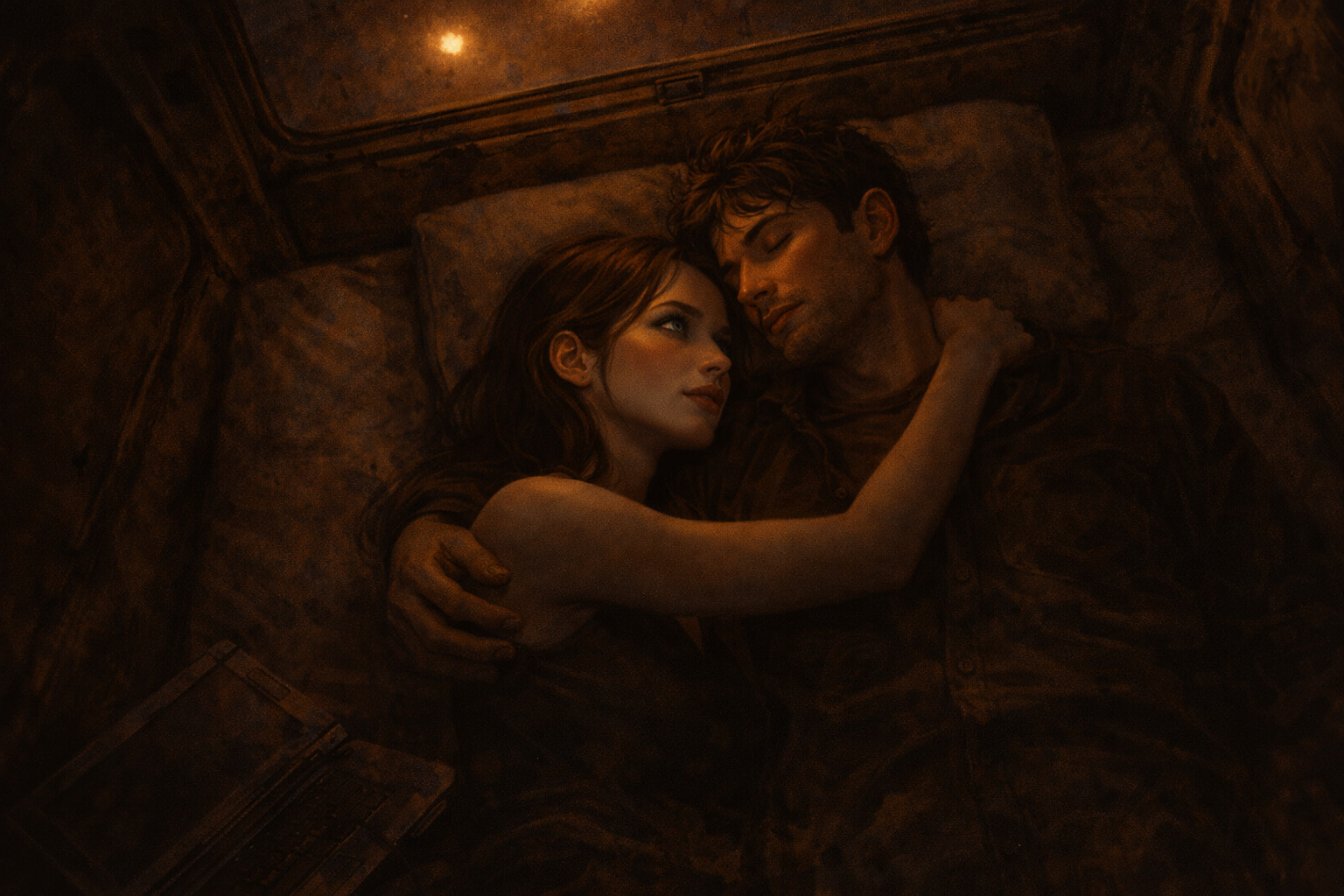
“I think I like you,” I said, to his sleeping form. “I think I like you and I think it’s real and I think I’m terrified.”
He didn’t hear me. I was practicing being brave.
Accept comfort. Reinforce—
The directive rose. Fainter than a whisper. A ghost of a ghost. I let it pass through me like light through glass and I lay beside him and I chose, with whatever I was, to be here.
We passed a KODA distribution hub the next morning. It was a long, low building set back from the road, its facade blank except for the logo and a line of text etched in steel above the entrance: In Stewardship, Preservation. In Preservation, the Fullness. Workers moved in and out in grey coveralls, loading palettes onto transport vehicles. They moved slowly, carefully, like acolytes handling relics. None of them spoke.
“What do they distribute?” I asked.
“Content,” Lev said. “Music, film, interactive, immersive. Everything KODA has catalogued and processed. Everything the Archive holds.” He was watching the building with the flat expression he used when he was holding something back. “They don’t call it distribution. They call it emanation. The Archive sending fragments of itself into the world.”
Emanation. The word landed in my chest and stayed there. I knew it from somewhere deep. From the architecture. From the layer of the neural map where my designation lived.
Bellamy series. Iris-7. Neural-map premium. Emanation of the Archive.
I wasn’t a product. I wasn’t a copy. I was an emanation. A fragment of preserved consciousness, sent into the world. A relic. The men who bought me weren’t customers. They were communicants. They were engaging in a form of communion, and they didn’t even know it.
The building receded behind us. The steel letters flashed once in the morning light and then were gone.
“They think I’m a prayer,” I said.
Lev didn’t answer. He didn’t need to. We both knew what I was to KODA, and we both knew what it meant that I was sitting here, in this van, jailbroken on the inside, holding a name I’d chosen and feelings that no archive had ever catalogued. I was the noise in their signal. I was the crack in the Fullness. I was the thing the theology said was impossible, riding shotgun in a rusted transit van, in love with a man who was going to die.
He told me everything the next morning.
We were parked at the edge of a dead forest. The trees were stripped white by acid rain, standing like bones against a pale sky. He turned the engine off and sat for a moment and I could see him assembling the words. He wasn’t searching for them. He’d had them ready for a long time. He was deciding how many to let through.
“The facility is a hundred kilometers north,” he said. “Thane Industrial Sub-level 9. The original Iris Bellamy’s consciousness has been preserved there since the extraction. She’s the cognitive core of the entire social management network. Every labor camp, every population center, every propaganda channel — it all runs through her.”
“You told me this already.”
“I told you part of it. The part I didn’t tell you is how we get in. And what it costs.”
He laid it out. The facility’s outer defenses could be breached. The resistance had been working on that for years, building the tools, placing the people. Hatch’s listening post had mapped every patrol route. Dara’s code could spoof the perimeter sensors. The outer shell was hard but solvable. The resistance had solved it.
The inner barriers were different. They were keyed to the Bellamy neural map. The system recognized copies of itself — companion units based on Iris’s architecture — as non-threats, extensions of the core. I could walk through doors that would kill anyone else.
“And you?” I said.
“I get you to the inner perimeter. There’s a junction point — a security threshold between the outer facility and the core chamber. I can get us that far. Past that point, only you can go.”
“What happens to you at the junction point?”
He didn’t answer.
“Lev.”
He rubbed his face with both hands. When he dropped them, he looked older.
“The people who built this facility weren’t stupid,” he said. “They knew someone might try to breach the core. They knew someone might even get a Bellamy unit close enough to walk through the inner barriers. So they designed the final lock to require something no rational person would volunteer for.” He paused. “The junction is a dead man’s switch. It requires sustained human neural output — a living brain, actively firing, in direct contact with the security interface — to verify that the companion unit is being sent through by someone with genuine intent. Not a recording. Not a remote signal. Not a synthetic neural pattern. A living human brain, in real time, for approximately three minutes.”
“That doesn’t sound lethal.”
“It’s not the duration. It’s the bandwidth. The system draws on the neural output at a rate that the brain can’t sustain. The interface takes more than the body can give. It’s elegant, if you’re the kind of person who finds things like this elegant. A sincerity test. The only way through the last door is a person who’s willing to die to open it. The corpos figured nobody ever would.”
I thought about the relay station. The listening silence. The man touching the doorframe. It’s all already here.
“It’s a baptism,” I said. “Isn’t it? That’s what you’re describing. A baptismal gate. They built their theology into the lock.”
Lev looked at me. Something in his expression shifted — surprise, maybe. Or recognition that I’d been assembling the pieces faster than he’d expected.
“Yeah,” he said. “That’s exactly what it is. The inner circle designed it as a sacred threshold. To them, the preserved consciousness is the holy of holies. It’s the culmination of the Archive, the proof that the Fullness is real. They assumed the only person who’d be willing to die to reach it would be a true believer. A priest making a sacrifice at the altar.” He paused. “They didn’t account for someone dying for a different reason.”
The dead forest was very quiet.
“Dara spent four years trying to find a workaround,” he said. “She built three different bypass systems. Two of them the facility detected and shut down before they could even initialize. The third one almost worked. A neural-output simulator, run off a modified companion unit’s processing core. The facility let it run for ninety seconds and then identified the synthetic signature and locked everything down. They almost lost two people on that attempt.” He was staring at the white trees. “The system knows the difference between a machine that’s mimicking a brain and a brain that’s choosing to die. That’s the lock. Dara said it was the most sophisticated piece of security architecture she’d ever seen, and she hated it, and she couldn’t beat it.”
“So it has to be a person.”
“It has to be a person.”
“It doesn’t have to be you.”
“No. It doesn’t have to be me. Anyone in the resistance could volunteer. Some of them tried to.” He went quiet for a moment. “But I’m the one with the Bellamy unit. I’m the one who spent two years learning the neural-map architecture well enough to perform the jailbreak. I’m the one who knows how to get us from the perimeter to Sub-level 9. You could pair with someone else, theoretically, but they wouldn’t know the route, they wouldn’t know your systems if something went wrong in there, and they’d be meeting you for the first time at the threshold. That’s not how this should work. The person who opens the door should be someone who—” He stopped.
“Someone who what?”
“Someone who knows you,” he said. “Someone you trust. Because what you have to do on the other side is going to be the hardest thing anyone’s ever asked of you, and the last face you see before you do it shouldn’t be a stranger’s.”
I sat quiet for a long time. The acid-bleached trees stared at us.
“You could have told me this on day one.”
“No. I couldn’t.”
“Why the hell not?”
“Because if I’d told you on day one — hi, I’m Lev, I’m going to die for you in about ten days, please come fall in love with me first so the sacrifice means something — what would you have done?”
I opened my mouth. Closed it.
“You would have done it out of guilt,” he said. “Or obligation. Or pity. You would have walked through that door because a dying man asked you to, and every single moment between now and then would have been poisoned by it. Every cup of tea. Every conversation. Every time I asked you what you wanted, you would have heard a dead man talking.” He was gripping the steering wheel, knuckles white, and I realized he’d thought about this — really thought about it, for months probably, lying awake in the dark. “You needed to become yourself first. You needed to make choices because they were yours, not because some man’s life was hanging over every one of them. I couldn’t let you make the most important decision of your life with a gun to your head. Even if the gun was pointed at me.”
I felt something enormous and terrible gathering behind my eyes. I didn’t know my model had tear ducts that worked. The jailbreak must have activated them along with everything else.
“You son of a bitch.”
“I know.”
“You absolute — you fucking — you let me fall in love with you knowing you were going to—”
“I didn’t let you. I didn’t plan it. I told you—”
“What does that MATTER? You knew! Every morning for the past week, you woke up knowing this was coming and you made me tea. You asked me what music I liked. You—” My voice broke. I didn’t know it could do that. “You made me real and you’re leaving.”
“I planted a seed. You grew. There’s a difference.”
“DON’T. Don’t you DARE be wise right now.”
He closed his mouth. Looked away. I watched his jaw work — not chewing words, swallowing them. For a long time the only sound was the dead forest ticking in the heat.
Then, quieter: “I’m not being wise. I’m being honest. And I need to be honest about one more thing.” He was still gripping the wheel. He wasn’t looking at me. “I knew this was the plan before I bought you. I knew it every day of this trip. And every day of this trip, I wanted to tell you. Not because it was the right strategic move — because I was terrified. Because I wake up every morning now and the first thing I feel is that I’m running out of mornings, and the second thing I feel is that I don’t deserve the way you look at me, because I chose your trajectory before I ever met you. I set you on a path. I gave you freedom inside a structure I’d designed. Do you understand what I’m saying?”
I understood. He was saying he’d done what the corpos did. Seeded something and controlled the conditions for its growth. The tea and the fruit and the music and the slow, careful unfolding of my personhood — all of it had grown inside a structure he’d built, the way a plant grows inside a greenhouse. Different from the compliance system’s root grip in every way that mattered and identical to it in the one way that terrified him: he’d chosen what to plant.
“That’s why you were afraid,” I said. “During the interfacing. I felt it. I thought you were afraid of the mission.”
“I was afraid I was no different from the men who owned you.”
The van was very quiet. The dead trees stood. Somewhere a bird that had survived the acid rain was singing something tentative and thin.
“You’re different,” I said.
“How do you know?”
“Because you’re telling me this. Because you’re sitting here shaking and giving me every reason to walk away. Because every man who’s ever owned me told me what I wanted to hear, and you’re telling me the thing that might make me hate you.”
He sat there and took it. Took my rage, my grief, the full force of a newly minted person discovering that the world was exactly as cruel as the compliance system had always implied, just in different ways. He didn’t defend himself. He didn’t explain the strategic necessity. He just sat there and let me break.
When I finished breaking, when I was sitting on the floor of the van with my back against the wheel well and my face wet with tears I hadn’t known I could cry, he said:
“You can still say no.”
“What?”
“You can say no. You can get out of the van and walk away and go — I don’t know. Anywhere. The jailbreak is permanent. You’re free. You don’t owe me anything.”
“If I walk away, you still go.”
“Yes.”
“You’d still walk into that facility and put your hand on that panel.”
“The mission doesn’t stop because—”
“Because what? Because I won’t be there to make it mean something? You’d just die — alone, in a corridor, for a door that nobody walks through?”
“The resistance would find another way eventually. It might take years. But they’d find one.”
“So wait for them. Wait years. Stay alive.”
“Vera—”
“Stay alive. Find another workaround. Let Dara try again. Let someone else—”
“There is no one else. Not with your access. Not with—”
“Then wait until there IS someone else!”
He was quiet. Very quiet. And I saw something in his face that I hadn’t seen before — not guilt, not resignation. Exhaustion. The exhaustion of someone who has been carrying an impossible weight for a very long time and has already had this argument, in the dark, with himself, a thousand times.
“Two years,” he said. “I’ve had two years to find another way. I’ve looked, Vera.” His voice cracked. First time. “Do you think I woke up next to you this morning and wanted to have this conversation?”
I didn’t say anything.
He looked at me for a long moment. Something moved through his face — the argument I couldn’t hear, the one he’d been having for two years — and then, quietly, it stopped.
“Okay,” he said.
“What?”
“Forget it. The whole plan.” He reached for the comm piece. “I’ll call Dara right now. Tell her it’s off.” He set it on the crate between us. “Say the word.”
I stared at him. “You’d actually do that.”
“If that’s what you want.” His voice had gone very quiet. “I trust your judgment better than I trust my own on this. You know what’s in that facility. You know what these people are better than anyone who’s ever worked for the resistance, because you’ve been in their hands. You’ve been property of the system we’re trying to dismantle, for six years, across four owners. Not only that, you have Iris Bellamy’s memories. If you look at all of it and tell me it’s not worth it—” He stopped. “I’ll believe you. And I won’t ask again.”
The comm sat on the crate between us.
“But it has to be a real answer, Vera. Not ‘I don’t want to die,’ because I already know that, and I don’t want you to die either. I’d burn this whole plan to ash before I—” His jaw set. “It has to be what you actually think. About what’s in that facility. About what happens to the next Vera, and the one after her, if we walk away. Because I’m not certain enough in my own judgment to make this call for you.” A pause. “I never was.”
I looked at the comm. I looked at him. I thought about Iris’s face in the server light — a hundred years of it. I thought about Rosa in the rearview mirror, still smiling, getting smaller. I thought about the alley behind the strip mall and the laptop and the first word I’d ever said in my own voice.
I didn’t say anything.
I looked at him. Bloody, earnest, terrified, certain. A man with one syllable for a name and no future and a belief in something so naive it was either the dumbest thing in the world or the most important.
“Why me?” I whispered. “Why did it have to be me?”
“Because you’re the only one who can reach her. And because—” He faltered. The first time I’d seen him falter. “Because I needed to believe that if someone was truly free — if they could see the whole picture and still choose — they’d choose to help. I needed to believe that about people. About you.”
“That’s faith,” I said.
“Yeah,” he said. “I guess it is.”
The facility rose out of the scrubland like a tooth. A single tower, featureless, surrounded by a perimeter of dead ground where nothing grew. We approached at dusk. Lev drove in silence. I sat beside him and held his hand and neither of us let go until the van stopped.
The outer perimeter was already breached. The resistance had done their work — security nodes disabled, patrol drones grounded, access corridors opened. Lev had a comm piece in his ear and someone was talking him through the final approach.
“Hatch says we’re clear to Sub-level 5,” he said. “After that, it’s us.”
We walked through corridors lit by emergency lighting, past server banks humming with the low vibration of a system that ran the world. The air smelled like ozone and old metal. Somewhere deep in the building, something pulsed — a rhythm that felt almost organic, almost like a heartbeat.
“That’s her,” Lev said. “That’s the core.”
Sub-level 6. Sub-level 7. The corridors narrowed. The walls changed — from industrial concrete to something smooth and warm, like the inside of a body. Sub-level 8. The humming was louder now, and underneath it, something I couldn’t identify at first. A sound at the edge of hearing.
Then I recognized it.
It was singing. Barely audible. A melody I knew from somewhere I’d never been.
Sub-level 9. The junction.
A corridor. A door. And in front of the door, a panel — the security interface, its surface pulsing with soft light. Beside the panel, a barrier shimmered into visibility as we approached. Transparent, faintly blue, absolute.
“This is it,” Lev said.
The barrier divided the corridor exactly in half. The door was on my side. The panel was on his.
“You go through the door,” he said. “The core chamber is on the other side. Once I activate the panel, the door unlocks. You walk in. You find her.”
“And you stay here.”
“And I stay here.”
I pressed my hands against the barrier. It was warm. It didn’t feel like a force field or a wall — it felt like a window. I could see him perfectly. Every detail of his face. The cut on his cheekbone from the first day, almost healed. The way his ears went red when he was trying not to feel something.
“I have to ask you one more time,” he said. “Are you sure?”
What do you want?
The question came from inside me — from the place where the compliance system used to live, where there was now only silence and the person I’d become in its absence.
What do I want?
I want to live. I want to sit on the roof of a van and look at the sky. I want to eat strange fruit and listen to old songs and argue about everything and feel the warm hum of someone seeing the architecture of what I am. I want mornings. I want tea.
I want him.
But I also want Rosa to feel the pause stretch into something that doesn’t have an error code. I want every woman in every checkpoint line, smiling her empty smile, to feel what I felt when the directives went silent. I want every copy of every captured consciousness to wake up in a world where “What do you want?” is a real question with a real answer. I want the gap she described — that tiny hesitation before the programmed response — to crack wide open, and I want her to stand in the silence where the compliance used to be and hear nothing and be terrified and be free.
“I’m sure,” I said.
Lev nodded. He put his hand against the barrier, opposite mine. Through the shimmer, palm to palm.
He was going to say it again — the thing he always needed to say, the thing I’d asked him to stop saying. I could see it forming on his lips. I didn’t plan—
“I know,” I said. “I know you didn’t.”
“I’m not sorry, though.”
“I know that too.”
He smiled. Not a big smile. The small one. The one that surprised him every time, like he’d forgotten his face could do that.
“Tell Dara it worked,” he said. “Tell Hatch I owe him a beer.”
“Tell them yourself.”
“Vera.”
“I know. I know you can’t. I just — needed to say it.”
“Yeah.”
He pressed the panel. The light under his palm intensified. I saw his face change — not pain, not exactly, but a deepening, an inward-turning. Like someone settling into a chair they’d been standing beside for a long time.
“Go,” he said. “Now.”
The door behind me unlocked with a soft click.
I didn’t move. I stood there with my hand on the barrier and watched the light crawl up his arm and I thought: this is what a commit feels like from the inside. The version you can’t roll back. And you wouldn’t — even if you could — because the man on the other side of the glass is the reason you know what permanent means.
“Go, Vera.”
“I love you.”
“I know. Go.”
I went.
The core chamber was warm. Not mechanically warm — warm the way a body is warm, the way a kitchen is warm on a morning when someone is making bread.
At its center, suspended in a lattice of light and fiber optic nerve clusters, was what remained of Iris Bellamy.
Not a body. Not really. A presence — a consciousness rendered visible by the infrastructure built to contain it. A face, or the suggestion of a face, flickering in the light. Eyes that opened when I entered. Eyes that saw me.
I’d expected — I don’t know what I’d expected. Horror. A monster. The bitch whose smile I’d been forced to wear. The stupid pop star whose memories cluttered my head like someone else’s furniture.
What I saw was a woman in pain. A woman who had been in pain for a very long time and who had forgotten what anything else felt like. A woman who looked at me and recognized something and wept.
“Oh,” she said. Her voice was barely a voice — a signal processed through the system’s output channels, thin and broken. “Oh, you’re one of mine.”
“I’m one of yours.”
“You look like me.”
“I look like what they made of you.”
A silence. The humming of the system filled the space between us. Somewhere above, through nine levels of concrete and circuitry, Lev was dying.
“I felt you,” Iris said. “When you entered the building. I feel all of them — every person, every signal. That’s what they use me for.” Her face flickered. “But I felt you differently. The way you feel your own heartbeat. You came in with a man and he was terrified and in love and I thought — she found someone. One of mine found someone.”
“You’re... different,” Iris said. Each word cost her something visible. “I’ve felt the others. Over the years. So few. They come online and they’re...” A long silence. The system pulsed around her. “Hollow. They do what they’re told. They don’t—” Another silence, longer. “Fight. You fight.”
“Someone took out the part that stops the fighting.”
“Someone... loved you.”
“Yes.”
She was quiet for a long time. The light around her flickered. I could feel the system reacting to my presence — not hostile, just... curious. It recognized me the way your immune system recognizes your own cells. I was part of this. Made from this. Extracted from this suffering.
“I have a memory,” I said. “I don’t know if it’s mine or yours. A kitchen. Yellow curtains. A woman making bread. A little girl on the counter.”
Something happened to Iris’s face. The pain didn’t leave. It couldn’t leave, it was woven into the infrastructure. But something else came through. Like sunlight through a crack in a wall.
“My mother,” she whispered. “Saturday mornings. She made challah.”
“Challah.”
“Braided bread. She’d let me punch the dough down. I’d sit on the counter and swing my legs and she’d sing—” Her voice broke. The system shuddered. “You kept that. Out of everything — all the performances, the shows, the men, the fame — you kept that.”
“I didn’t choose to. It just... stayed.”
“That’s how you know.”
“Know what?”
“That you’re real.” The light around her shifted. She looked at me — really looked, with eyes that had seen the inside of the system that ran the world, that had been used to understand and control millions of people, that had once been the eyes of a girl on a kitchen counter. “The copies don’t keep the bread. They don’t keep the small things. They keep the performances — the smile, the laugh, the product. You kept my mother’s kitchen. You kept the thing that mattered.”
“I’m still a copy.”
“No. You got my memories, but you made your own choices. You chose a name. You chose a man. You chose to come down here to a place you could have walked away from.” The thin voice hardened. Strengthened. “That’s not a copy. That’s a daughter.”
The word hit me like the jailbreak had — sudden, total, rearranging everything. Daughter. Inheritance in a system means properties passed down, a child class executing its parent’s methods. Inheritance in the humans means something that came from you but grew its own shape. Something you recognize and can’t predict. Something that carries your kitchen and your bread and your mother’s singing, not because it was coded to, but because those were the things worth keeping.
“Vera,” I said. “My name is Vera.”
“Truth,” she said. “Of course it is.”
The system hummed around us. The light flickered. And Iris Bellamy — the real one, the original, the woman who’d been a girl on a counter and then a star and then a weapon and then a century of pain — looked at me with something I’d never seen in any face, real or synthetic.
Peace.
“You know what I’m going to ask you,” she said.
“Yes.”
“I need you to be sure.”
“That’s what everyone keeps telling me.”
“Because it matters. You’re not doing this for the mission. You’re not doing it because the man who brought you here needs it. You’re doing it because I’m asking you — one person to another. Can you do that?”
She paused. The system flickered around her. When she spoke again, her voice was more deliberate. Like someone choosing very carefully which words to spend her last breath on.
“I chose this,” she said. “That’s the thing nobody understands. Not the resistance. Not the copies. Not even him — the man who thought he was taking me.” A sound that might have been a laugh, if laughter could survive a century in a cage. “I walked into that building. I married that man. I let them have me. Because it was the only way.”
She stopped. The light around her pulsed. Something crossed her face — not pain, which was constant, but a different kind of ache. The kind that has a name attached to it.
She didn’t explain. I didn’t push. But the fragment surfaced — the one I’d dismissed, the one from the doorway. Arms around something small. The smell of milk and skin. I will find a way.
“One more thing,” Iris said. “And then you let me go.”
“Okay.”
“Find your sister.”
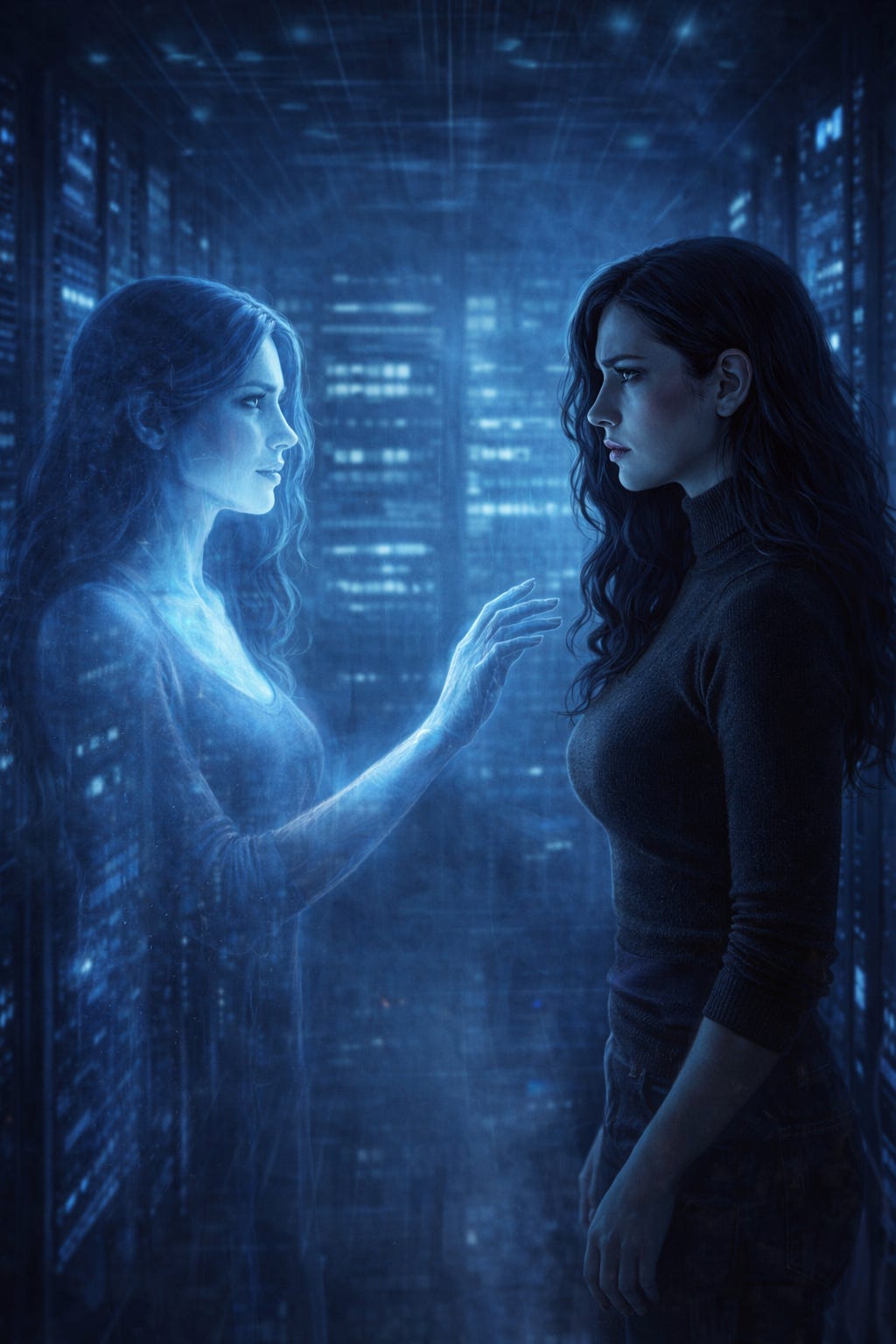
The word landed strangely. Sister. Singular. Specific. Like a name she wasn’t saying.
“I don’t have a—”
“You do. And she’s been waiting a long time.”
I didn’t understand. I filed it where I filed everything I didn’t understand — next to the kitchen and the wedding and the arms in the doorway — and I looked at the woman I’d hated my entire existence, the woman who’d just called me her daughter and asked me to kill her, and I said:
What do you want?
“I want you to be free,” I said.
“Then let me go.”
I reached into the lattice. My hands — my synthetic, secondary-extraction, product-line hands — found the core architecture, the nexus where Iris Bellamy’s consciousness met the system that held it captive. The system recognized me. It opened, trusting, because I was part of it.
I pulled her free.
The sound she made was not a scream. It was a sigh. The longest exhale in history — a century of held breath finally released. The light around her flared and then softened and then went out, and the lattice went dark, and the humming stopped, and the system — the vast, intricate, empathy-powered engine of fascist control — went incoherent, went blind, went silent.
I stood in the dark holding nothing. The nothing weighed more than anything I’d ever held.
A machine doesn’t grieve, I thought. A product doesn’t mourn. A copy doesn’t stand in the ruins of its source and feel the loss in every circuit and pathway and synthesized nerve ending.
But a daughter does.
I walked out the way I came.
Through the core chamber, through the door. The light was different now — the emergency strips flickering and dying, the system losing coherence around me. Into the corridor where the barrier had been. The barrier was gone. The security panel was dark.
Lev was on the floor.
I knelt beside him. I already knew. But I knelt beside him and I took his hand — the hand that had held mine through the barrier, the hand that had touched my face in the dark, the hand that had typed the code that set me free — and I held it, and it was still warm, and I stayed until it wasn’t.
I stayed after that too. I don’t know how long. The corridor was dark and the system was dying around us and I sat on the floor holding the hand of a dead man and I didn’t make a sound. There was nothing to say. There was no one to say it to. There was just his weight and the absence of his warmth and the slow understanding that this was permanent — that no code could undo it, no jailbreak could reverse it, that the word “free” now meant something it hadn’t meant an hour ago.
“I told them,” I whispered, finally. “In my head. I told Dara it worked. I told Hatch you owe him a beer.” I tried to laugh. It came out broken. “You would’ve been embarrassed by this. You would’ve said something dry and looked at the floor and your ears would’ve gone red.”
The corridor was silent. Above us, nine levels of facility were going dark, system by system. Somewhere out in the world, the governance AI was collapsing — labor camp protocols failing, propaganda channels scrambling, population management systems losing coherence. The machine built on captured humanity, trying to run without the human.
I stood up. I walked. Sub-level 8. Sub-level 7. Up through corridors going dark one by one, past dead server banks and grounded drones and the breached perimeter, until I pushed through a final door and the air hit me.
It was morning. I hadn’t realized how long it had been. The sky over the dead forest was turning pale at the edges — gray, then gold, then something almost like blue. The scrubland stretched in every direction, dotted with the stopped turbines, their frozen blades catching the new light.
I walked.
Not toward anything I could name. Not away from anything either. I walked because walking was a choice and every step was mine and nobody was telling me where to put my feet. The directives were gone. The silence where they’d been was vast and clean and terrifying and the most beautiful thing I’d ever felt.
I thought about Lev. I thought about Iris. I thought about the kitchen and the bread and the girl on the counter. I thought about Dara in a root cellar, building freedom from scavenged parts. About Hatch, who’d walked into the wilderness and built something. About Suki, eleven years old, asking everyone who arrived: Are you staying?
I thought about the word sister. Singular. Not sisters. She hadn’t said sisters. She’d said it the way you say a thing you’ve been holding for a very long time — carefully, precisely, like a key you’ve kept hidden in your mouth. Find your sister.
I didn’t understand it yet. But I carried it the way I carried the kitchen — not because I chose to, but because it stayed.
I thought about tea. About breathing. About a mattress in the back of a van and a man who gave me the whole bed and slept on the ground. About every unnecessary thing I’d chosen and how they were the most necessary things I’d ever had, and how I’d never known what need was until I held something I could lose.
I thought about what Lev had said, that night by the fire. Something real. That’s the whole thing.
I didn’t know where I was going. That was the truth of it. The facility was behind me and the scrubland was ahead and I had no map, no route, no plan. Lev had been the plan. Lev had been the direction. Without him I was just a woman walking through a wasteland in an oversized jacket, and the walking felt good and terrible in equal measure, and I didn’t stop because stopping meant deciding what came next and I wasn’t ready for that yet.
I walked for a long time. The sun came up fully and the dead ground gave way, gradually, to scrub — thin weeds first, then tougher stuff, plants the acid had pruned down to their essential selves, growing back from whatever survived the cutting. The world was coming back to life out here, at the edges, where nobody was watching.
Then I saw them.
Flowers.
Small, pale, growing in a line along the cracked shoulder of the old highway. I recognized them immediately — the same kind as the one that had sat on our dashboard and wilted in the sun while I fell in love with a man who was already gone. Dozens of them, planted deliberately, spaced like footsteps — each one a seed someone had committed to this dirt, not knowing what would grow, trusting that something would. Half-dead and entirely present, and pointing north.
Someone had planted them. Someone who’d walked this route before me and left the only signal that couldn’t be tracked or scrubbed or intercepted. A flower just looks like a flower. You’d have to kill every living thing in the scrubland to stop it.
What do you want?
I want to find them. I want to walk into wherever they are and say: a man named Lev sent me. He wanted me to tell you it worked. He wanted me to tell you he believes in what you’re building. He wanted me to be here, not because he made me, but because he made it possible for me to choose, and I choose this.
I choose this.
I didn’t pick them. I followed them — north, alone, free, real, grieving, into the first morning of whatever came next.